
- Home
- About
- Services
- Specialists
- Research
- Achivements
- gallery
- contact




- Home
- About Us
- Orthopedics
- Know Your Alignment
- Sports Medicine
- Knee
- Arthroscopic ACI Cartilage Transplant
- Arthroscopic ACL Avulsion Fixation
- Arthroscopic ACL Primary Repair
- Arthroscopic ACL Reconstruction – All Inside Technique
- Arthroscopic ACL Rehab
- Arthroscopic ACL Revision Surgery
- Arthroscopic ACL Single Bundle Reconstruction
- Arthroscopic assisted MPFL Reconstruction
- Arthroscopic assisted Multiple Ligament Tear – SURGERY
- Arthroscopic Medial Meniscal Repair
- Arthroscopic OATS Chondroplasty
- Arthroscopic OCD Fixation
- Arthroscopic Paediatric ACL Reconstruction
- Arthroscopic PCL Avulsion Fixation
- Arthroscopic PCL Reconstruction
- Arthroscopy Assisted STEM Cell Cartilage Transplant
- PCL Rehabilitation
- Total Knee Replacement
- Shoulder
- Arthroscopic Rotator Cuff Repair
- Arthroscopic Bankart Repair
- Arthroscopy Assisted Latarjet Surgery
- AC Joint Fixation
- Arthroscopic Capsular Release
- Arthroscopic Sub – Acromial Decompression (SAD)
- Arthroscopic Calcific Tendinitis Excision
- Arthroscopic Biceps Tenodesis
- Arthroscopic SLAP Repair
- Arthroscopic Revision Cuff Repair
- Arthroscopic Revision Bankart Repair
- Shoulder Rehab
- Elbow
- Wrist
- Hip
- Ankle
- Our Specialities
- Cardiology
- Gastroenterology
- Radiology
- Internal Medicine & Diabetology
- Anesthesiology & Intensive Care Unit
- Neurology
- Nephrology
- Urology
- Oncology
- Rheumatology
- Endocrinology
- General Surgery
- Laparoscopic Surgery
- Podiatric / Diabetic Foot Clinic
- Obstetrics & Gynecology
- ENT
- Plastic & Cosmetic Surgery
- Paediatrics
- Pulmonology
- Psychiatry
- Vascular Surgery
- Dermatology
- Oral and Maxillofacial Surgery
- Our Services
- Resource
- Enquiry
- Home
- About Us
- Orthopedics
- Know Your Alignment
- Sports Medicine
- Knee
- Arthroscopic ACI Cartilage Transplant
- Arthroscopic ACL Avulsion Fixation
- Arthroscopic ACL Primary Repair
- Arthroscopic ACL Reconstruction – All Inside Technique
- Arthroscopic ACL Rehab
- Arthroscopic ACL Revision Surgery
- Arthroscopic ACL Single Bundle Reconstruction
- Arthroscopic assisted MPFL Reconstruction
- Arthroscopic assisted Multiple Ligament Tear – SURGERY
- Arthroscopic Medial Meniscal Repair
- Arthroscopic OATS Chondroplasty
- Arthroscopic OCD Fixation
- Arthroscopic Paediatric ACL Reconstruction
- Arthroscopic PCL Avulsion Fixation
- Arthroscopic PCL Reconstruction
- Arthroscopy Assisted STEM Cell Cartilage Transplant
- PCL Rehabilitation
- Total Knee Replacement
- Shoulder
- Arthroscopic Rotator Cuff Repair
- Arthroscopic Bankart Repair
- Arthroscopy Assisted Latarjet Surgery
- AC Joint Fixation
- Arthroscopic Capsular Release
- Arthroscopic Sub – Acromial Decompression (SAD)
- Arthroscopic Calcific Tendinitis Excision
- Arthroscopic Biceps Tenodesis
- Arthroscopic SLAP Repair
- Arthroscopic Revision Cuff Repair
- Arthroscopic Revision Bankart Repair
- Shoulder Rehab
- Elbow
- Wrist
- Hip
- Ankle
- Our Specialities
- Cardiology
- Gastroenterology
- Radiology
- Internal Medicine & Diabetology
- Anesthesiology & Intensive Care Unit
- Neurology
- Nephrology
- Urology
- Oncology
- Rheumatology
- Endocrinology
- General Surgery
- Laparoscopic Surgery
- Podiatric / Diabetic Foot Clinic
- Obstetrics & Gynecology
- ENT
- Plastic & Cosmetic Surgery
- Paediatrics
- Pulmonology
- Psychiatry
- Vascular Surgery
- Dermatology
- Oral and Maxillofacial Surgery
- Our Services
- Resource
- Enquiry


- Home
- About Us
- Orthopedics
- Know Your Alignment
- Sports Medicine
- Knee
- Arthroscopic ACI Cartilage Transplant
- Arthroscopic ACL Avulsion Fixation
- Arthroscopic ACL Primary Repair
- Arthroscopic ACL Reconstruction – All Inside Technique
- Arthroscopic ACL Rehab
- Arthroscopic ACL Revision Surgery
- Arthroscopic ACL Single Bundle Reconstruction
- Arthroscopic assisted MPFL Reconstruction
- Arthroscopic assisted Multiple Ligament Tear – SURGERY
- Arthroscopic Medial Meniscal Repair
- Arthroscopic OATS Chondroplasty
- Arthroscopic OCD Fixation
- Arthroscopic Paediatric ACL Reconstruction
- Arthroscopic PCL Avulsion Fixation
- Arthroscopic PCL Reconstruction
- Arthroscopy Assisted STEM Cell Cartilage Transplant
- PCL Rehabilitation
- Total Knee Replacement
- Shoulder
- Arthroscopic Rotator Cuff Repair
- Arthroscopic Bankart Repair
- Arthroscopy Assisted Latarjet Surgery
- AC Joint Fixation
- Arthroscopic Capsular Release
- Arthroscopic Sub – Acromial Decompression (SAD)
- Arthroscopic Calcific Tendinitis Excision
- Arthroscopic Biceps Tenodesis
- Arthroscopic SLAP Repair
- Arthroscopic Revision Cuff Repair
- Arthroscopic Revision Bankart Repair
- Shoulder Rehab
- Elbow
- Wrist
- Hip
- Ankle
- Our Specialities
- Cardiology
- Gastroenterology
- Radiology
- Internal Medicine & Diabetology
- Anesthesiology & Intensive Care Unit
- Neurology
- Nephrology
- Urology
- Oncology
- Rheumatology
- Endocrinology
- General Surgery
- Laparoscopic Surgery
- Podiatric / Diabetic Foot Clinic
- Obstetrics & Gynecology
- ENT
- Plastic & Cosmetic Surgery
- Paediatrics
- Pulmonology
- Psychiatry
- Vascular Surgery
- Dermatology
- Oral and Maxillofacial Surgery
- Our Services
- Resource
- Enquiry
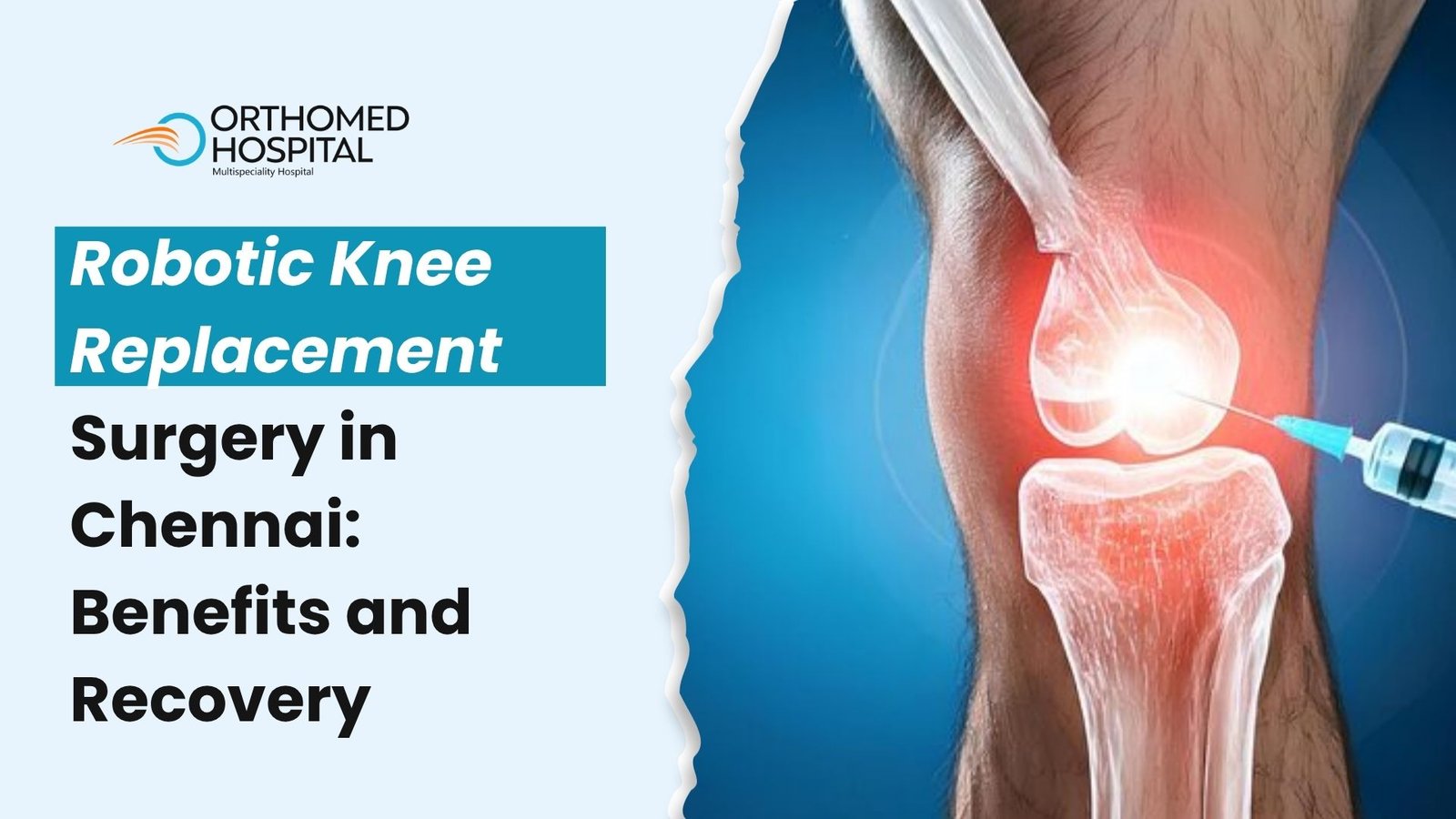
Robotic Knee Replacement Surgery in Chennai: Benefits, Procedure, and Recovery Guide
Knee pain can make even the simplest activities—walking, climbing stairs, or getting out of bed—feel challenging. For individuals suffering from severe arthritis or chronic knee joint damage, robotic knee replacement surgery in Chennai offers a highly advanced and precise solution that can restore mobility and improve quality of life.
Chennai has become a preferred destination for orthopedic treatments, with many hospitals offering cutting-edge robotic-assisted technology and expert joint replacement surgeons. If you are considering surgery, understanding the procedure, benefits, and recovery process can help you make an informed decision.
What Is Robotic Knee Replacement Surgery?
Robotic knee replacement surgery is a technologically advanced form of knee replacement in which a robotic system assists the surgeon during the operation. Despite the name, the robot does not perform the surgery independently. Instead, it helps the surgeon plan and execute the procedure with exceptional precision.
This advanced approach ensures:
- Accurate bone cuts
- Optimal implant positioning
- Better alignment of the joint
- Preservation of healthy tissues
The result is a more natural-feeling knee with improved function and longevity.
Why Consider Robotic Knee Replacement Surgery in Chennai?
Chennai is recognized as one of India’s leading healthcare hubs, offering world-class orthopedic care at affordable costs. Patients from across India and abroad choose Chennai for robotic-assisted joint replacement because of:
- Highly experienced orthopedic surgeons
- International-standard hospitals
- Advanced robotic surgical systems
- Comprehensive rehabilitation facilities
- Cost-effective treatment packages
If you are searching for a reliable knee replacement hospital in Chennai, you will find numerous multispecialty hospitals equipped with state-of-the-art robotic technology.
Conditions That May Require Knee Replacement Surgery
Your doctor may recommend knee replacement when non-surgical treatments such as medications, injections, and physiotherapy no longer provide relief.
Common conditions include:
Osteoarthritis
The most common cause, where cartilage wears away over time.
Rheumatoid Arthritis
An autoimmune disease that causes chronic joint inflammation.
Post-Traumatic Arthritis
Arthritis resulting from previous injuries.
Severe Knee Deformity
Bow-legged or knock-kneed conditions affecting function.
Chronic Knee Pain
Persistent pain that interferes with daily life and sleep.
How Robotic Joint Replacement Works
The process of robotic joint replacement begins with a CT scan or 3D imaging of your knee. The robotic software creates a customized surgical plan tailored to your anatomy.
During surgery:
- The surgeon maps the knee anatomy.
- The robotic arm guides bone preparation.
- The surgeon places the implant with precise alignment.
- Real-time data ensures accuracy throughout the procedure.
This personalized approach improves the overall outcome and implant performance.
Benefits of Robotic Knee Replacement Surgery
1. Superior Precision
Robotic systems allow surgeons to position implants with sub-millimeter accuracy.
2. Personalized Surgical Planning
Each procedure is customized according to the patient’s unique anatomy.
3. Less Damage to Soft Tissue
Robotic assistance minimizes trauma to surrounding muscles and ligaments.
4. Reduced Pain After Surgery
Less tissue disruption often means less postoperative pain.
5. Faster Recovery
Patients can usually walk sooner and return to normal activities more quickly.
6. Improved Implant Longevity
Proper alignment reduces wear and increases implant lifespan.
7. Better Functional Outcomes
Patients often report a more natural-feeling knee and improved movement.
Who Is a Good Candidate for Robotic Knee Replacement?
You may be a suitable candidate if you:
- Have severe knee pain or stiffness
- Have advanced osteoarthritis
- Experience difficulty walking or climbing stairs
- Have not responded to medications or injections
- Have knee deformity
- Are medically fit for surgery
An orthopedic surgeon will evaluate your condition and recommend the best treatment plan.
Robotic Knee Replacement Procedure: Step-by-Step
Preoperative Evaluation
Before surgery, your doctor will order:
- Blood tests
- ECG
- X-rays
- CT scan
- Medical fitness assessment
Anesthesia
The surgery is typically performed under spinal or general anesthesia.
Surgical Procedure
The damaged bone and cartilage are removed, and artificial implants are placed with robotic assistance.
Duration
The procedure usually takes 1 to 2 hours.
Hospital Stay
Most patients stay in the hospital for 3 to 5 days.
Types of Robotic Knee Replacement
Total Knee Replacement (TKR)
The entire knee joint is replaced.
Partial Knee Replacement
Only the damaged part of the knee is replaced.
Bilateral Knee Replacement
Both knees are replaced in one surgery or staged procedures.
Robotic vs Traditional Knee Replacement
| Feature | Traditional Surgery | Robotic-Assisted Surgery |
|---|---|---|
| Surgical Planning | Standard | Personalized 3D planning |
| Implant Positioning | Manual | Highly precise |
| Bone Cuts | Conventional instruments | Robotic guidance |
| Soft Tissue Damage | More | Less |
| Recovery | Standard | Often faster |
| Implant Alignment | Good | More accurate |
Cost of Robotic Knee Replacement Surgery in Chennai
The cost varies depending on:
- Hospital infrastructure
- Surgeon’s expertise
- Type of implant
- Medical condition
- Length of hospital stay
On average, robotic knee replacement surgery in Chennai may cost between ₹2.5 lakhs and ₹5.5 lakhs per knee.
Choosing the Best Knee Replacement Hospital in Chennai
When selecting a knee replacement hospital in Chennai, consider:
- Availability of robotic technology
- Experienced joint replacement surgeons
- Success rates
- Infection control measures
- Physiotherapy and rehabilitation support
- Transparent pricing
- Patient reviews
Recovery After Robotic Knee Replacement Surgery
One of the biggest advantages of robotic surgery is faster and smoother rehabilitation.
Day 1 After Surgery
- Begin walking with support
- Start physiotherapy
- Pain management
Week 1–2
- Continue exercises
- Improve range of motion
- Walk with walker or crutches
Week 3–6
- Increased strength and flexibility
- Reduced swelling
- Resume basic daily activities
6 Weeks to 3 Months
- Significant improvement in mobility
- Return to driving (with doctor approval)
- Light recreational activities
3–6 Months
- Full recovery for most patients
Knee Replacement Recovery Tips
Proper knee replacement recovery requires dedication and consistency.
Follow Physiotherapy Instructions
Daily exercises are essential.
Manage Pain and Swelling
Use prescribed medications and ice packs.
Keep the Surgical Site Clean
Prevent infection by following wound care instructions.
Eat a Healthy Diet
Include protein, vitamins, and calcium.
Stay Active
Gradually increase walking distance.
Avoid High-Impact Activities
Do not run or jump until your doctor permits.
What to Expect After Recovery
Most patients experience:
- Significant pain relief
- Better mobility
- Improved sleep
- Ability to walk longer distances
- Enhanced quality of life
Artificial knee implants can last 15 to 25 years or more with proper care.
Risks and Complications
Although robotic surgery improves accuracy, every surgery carries some risks.
Possible complications include:
- Infection
- Blood clots
- Implant loosening
- Nerve injury
- Persistent stiffness
- Rare need for revision surgery
Choosing an experienced surgeon significantly reduces these risks.
Success Rate of Robotic Knee Replacement
Robotic-assisted knee replacement has shown excellent outcomes with high patient satisfaction and implant survival rates.
Studies indicate that better alignment and precision can contribute to improved function and potentially longer-lasting implants.
Lifestyle After Knee Replacement
After recovery, most patients can enjoy:
- Walking
- Swimming
- Cycling
- Golf
- Yoga (with modifications)
Avoid high-impact sports such as running and basketball unless advised by your surgeon.
Why Robotic Joint Replacement Is the Future of Orthopedics
The growing popularity of robotic joint replacement is driven by:
- Improved precision
- Personalized surgery
- Better outcomes
- Reduced complications
- Faster rehabilitation
As technology advances, robotic-assisted surgery is becoming the gold standard for joint replacement procedures.
Final Thoughts
If knee pain is limiting your life, robotic knee replacement surgery in Chennai offers a highly effective and precise solution. With advanced robotic systems, skilled orthopedic surgeons, and world-class hospitals, Chennai provides excellent treatment options for patients seeking pain relief and restored mobility.
Whether you are exploring options for yourself or a loved one, consulting a trusted knee replacement hospital in Chennai can help you determine if robotic-assisted surgery is the right choice. With proper rehabilitation and follow-up care, most patients achieve excellent outcomes and return to an active, pain-free lifestyle.
Frequently Asked Questions (FAQs)
1. What is robotic knee replacement surgery?
It is a technology-assisted procedure where a robotic system helps the surgeon perform knee replacement with greater accuracy.
2. Is robotic knee replacement better than traditional surgery?
It offers improved precision, better alignment, and often faster recovery compared to conventional methods.
3. How long does knee replacement recovery take?
Most patients recover substantially within 6 to 12 weeks, with full recovery taking 3 to 6 months.
4. How much does robotic knee replacement surgery in Chennai cost?
The cost typically ranges from ₹2.5 lakhs to ₹5.5 lakhs per knee, depending on several factors.
5. How long does the surgery take?
The procedure generally takes 1 to 2 hours.
6. When can I walk after surgery?
Most patients begin walking with assistance within 24 hours.
7. How long do knee implants last?
Modern implants often last 15 to 25 years or longer.
8. Is robotic knee replacement painful?
Pain is expected initially, but it is well managed with medications and decreases significantly over time.
9. Can elderly patients undergo robotic knee replacement?
Yes, provided they are medically fit for surgery.
10. How do I choose the best knee replacement hospital in Chennai?
Look for experienced surgeons, advanced robotic technology, excellent rehabilitation support, and strong patient reviews.
Comments are closed