
- Home
- About
- Services
- Specialists
- Research
- Achivements
- gallery
- contact




- Home
- About Us
- Orthopedics
- Know Your Alignment
- Sports Medicine
- Knee
- Arthroscopic ACI Cartilage Transplant
- Arthroscopic ACL Avulsion Fixation
- Arthroscopic ACL Primary Repair
- Arthroscopic ACL Reconstruction – All Inside Technique
- Arthroscopic ACL Rehab
- Arthroscopic ACL Revision Surgery
- Arthroscopic ACL Single Bundle Reconstruction
- Arthroscopic assisted MPFL Reconstruction
- Arthroscopic assisted Multiple Ligament Tear – SURGERY
- Arthroscopic Medial Meniscal Repair
- Arthroscopic OATS Chondroplasty
- Arthroscopic OCD Fixation
- Arthroscopic Paediatric ACL Reconstruction
- Arthroscopic PCL Avulsion Fixation
- Arthroscopic PCL Reconstruction
- Arthroscopy Assisted STEM Cell Cartilage Transplant
- PCL Rehabilitation
- Total Knee Replacement
- Shoulder
- Arthroscopic Rotator Cuff Repair
- Arthroscopic Bankart Repair
- Arthroscopy Assisted Latarjet Surgery
- AC Joint Fixation
- Arthroscopic Capsular Release
- Arthroscopic Sub – Acromial Decompression (SAD)
- Arthroscopic Calcific Tendinitis Excision
- Arthroscopic Biceps Tenodesis
- Arthroscopic SLAP Repair
- Arthroscopic Revision Cuff Repair
- Arthroscopic Revision Bankart Repair
- Shoulder Rehab
- Elbow
- Wrist
- Hip
- Ankle
- Our Specialities
- Cardiology
- Gastroenterology
- Radiology
- Internal Medicine & Diabetology
- Anesthesiology & Intensive Care Unit
- Neurology
- Nephrology
- Urology
- Oncology
- Rheumatology
- Endocrinology
- General Surgery
- Laparoscopic Surgery
- Podiatric / Diabetic Foot Clinic
- Obstetrics & Gynecology
- ENT
- Plastic & Cosmetic Surgery
- Paediatrics
- Pulmonology
- Psychiatry
- Vascular Surgery
- Dermatology
- Oral and Maxillofacial Surgery
- Our Services
- Resource
- Enquiry
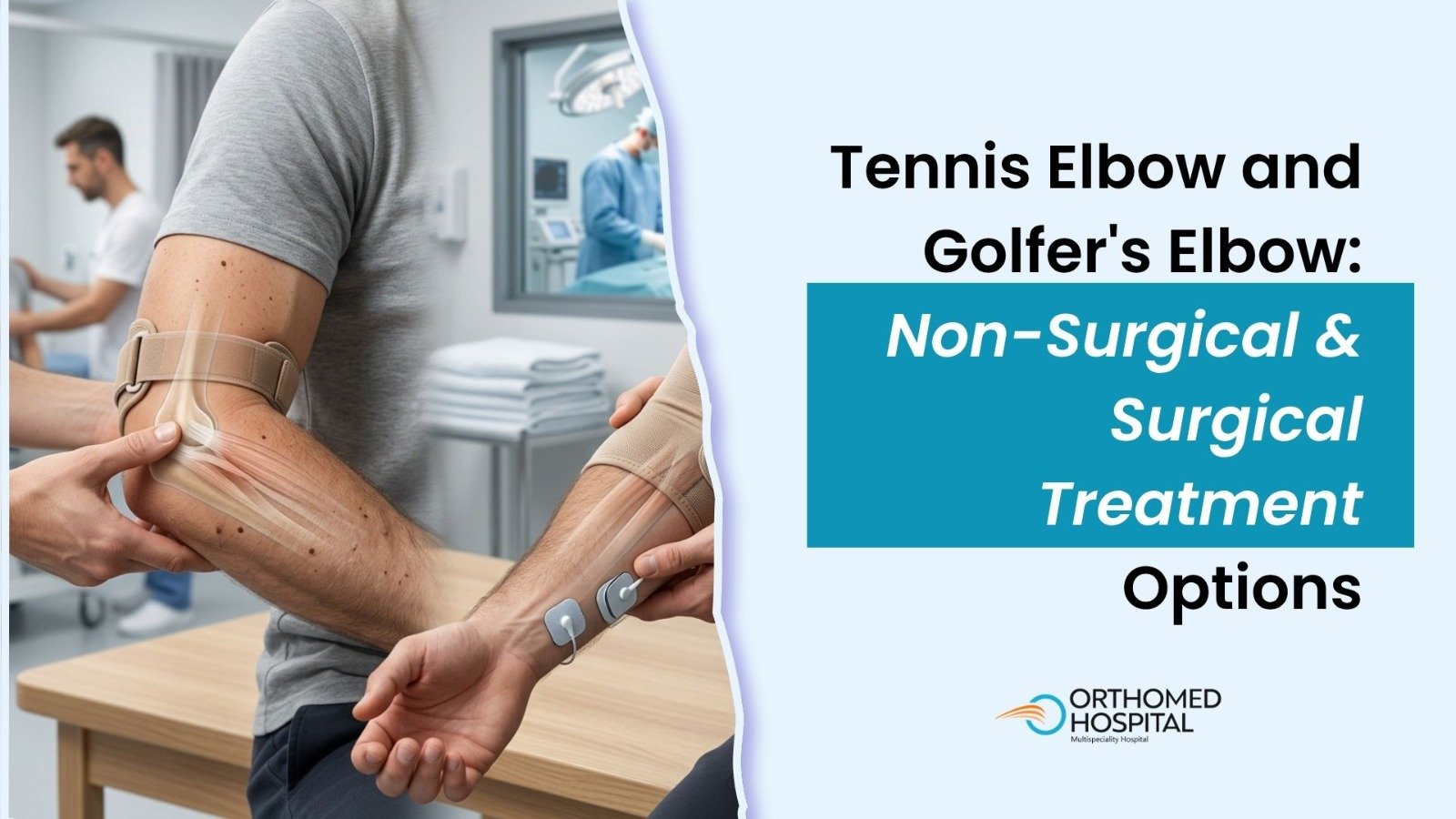
Tennis Elbow and Golfer's Elbow: Non-Surgical and Surgical Treatment Options
Have you ever experienced a sudden, sharp pinch on the side of your elbow while picking up a morning cup of coffee, turning a doorknob, or clicking your computer mouse at work? Or perhaps you notice a deep, nagging ache after a weekend badminton match or gym workout that makes simply shaking hands with a colleague feel agonizing.
If so, you might be dealing with one of two very common overuse tendon injuries: tennis elbow or golfer’s elbow.
Despite their sporty names, you do not need to play competitive racket sports or spend weekends on a golf course to develop these conditions. In fact, the overwhelming majority of people who suffer from them are office professionals, desk workers, home cooks, carpenters, musicians, and fitness enthusiasts. Anyone whose daily routine involves repetitive wrist movements, heavy gripping, or forearm strain can fall victim to these stubborn tendon conditions.
In fast-moving corporate and industrial hubs like Chennai, where hours of non-stop computer work meet active weekend sports routines, repetitive strain injuries are on the rise. Living with constant arm discomfort can disrupt your job, sideline your athletic goals, and turn simple daily chores into painful challenges.
The encouraging news is that over ninety percent of cases heal completely without open surgery. Understanding how these injuries develop, recognizing the differences between golfers elbow vs tennis elbow, and knowing the latest non-surgical and surgical options for tennis elbow treatment Chennai will help you take the right steps toward pain-free movement.
Anatomy of the Elbow: How Repetitive Strain Happens
To understand why your elbow hurts, it helps to look at the joint not as a simple hinge, but as an anchor point for your hands and wrists.
Your elbow joint is formed by three bones: the upper arm bone (humerus) and the two forearm bones (radius and ulna). At the bottom end of the humerus, there are two distinct bony bumps that you can easily feel with your fingers:
- Lateral Epicondyle: The bony bump located on the outside of your elbow.
- Medial Epicondyle: The bony bump located on the inside of your elbow, closest to your body.
These two bony bumps serve as the primary attachment sites for the tendons that control your wrists and fingers. Tendons are tough, flexible bands of fibrous collagen that connect muscle to bone.
Every single time you type on a keyboard, write with a pen, lift a shopping bag, chop vegetables, or swing a racket, these forearm muscles pull directly on those small anchor points.
When you repeat these motions thousands of times without giving your tendons adequate time to rest and rebuild, microscopic tears develop in the tissue. In medical terms, this condition is known as a tendinopathy. The tendon fibers become disorganized, blood flow to the area is limited, and chronic soreness sets in.
Golfers Elbow vs Tennis Elbow: Key Differences
While both conditions stem from repetitive tendon stress, they affect completely different sides of your arm and cause distinct physical limitations.
Feature | Tennis Elbow (Lateral Epicondylitis) | Golfer’s Elbow (Medial Epicondylitis) |
Medical Term | Lateral Epicondylitis | Medial Epicondylitis |
Location of Pain | Outer side of the elbow joint | Inner side of the elbow joint |
Primary Tendon Affected | Extensor Carpi Radialis Brevis (ECRB) | Flexor Carpi Radialis and Pronator Teres |
Aggravating Actions | Lifting objects with palm facing down, typing, gripping a mouse | Gripping tightly, flexing wrist downward, throwing a ball |
Radiating Discomfort | Often travels down the outer forearm toward the back of the wrist | Often radiates down the inner forearm toward the little finger |
Grip Strength Impact | Severe weakness when extending wrist or lifting glasses | Weakness when squeezing, holding tools, or twisting jars |
Knowing the exact location of your tenderness gives your doctor immediate insight into which muscle group is strained, allowing for an accurate, targeted rehabilitation plan.
Common Elbow Pain Causes in Everyday Life
Many patients walk into an orthopedic clinic puzzled, saying, “I have never held a tennis racket or golf club in my life. Why do I have this condition?”
Here are the most common everyday elbow pain causes that place repetitive mechanical strain on the forearm tendons:
Long Hours of Computer and Desk Work
In tech corridors along OMR, Guindy, and T. Nagar in Chennai, software developers, analysts, and designers spend eight to ten hours daily clicking mice and typing. Resting the forearm on hard desk edges while typing with bent wrists places static tension on the wrist extensor tendons, leading to chronic outer elbow pain.
Repetitive Household Chores
Cooking for a large family involves continuous wrist actions: chopping hard vegetables, lifting heavy cast iron pans, stirring thick gravies, and wringing out wet clothes by hand. These twisting motions place repetitive stress on both the medial and lateral epicondyles.
Trades and Manual Work
Plumbers, electricians, painters, carpenters, and assembly line workers rely heavily on repetitive, forceful forearm rotations. Using screwdrivers, wrenches, hammers, and paint rollers day after day strains the anchor points of the elbow tendons.
Gym and Weightlifting Mistakes
Lifting heavy weights with improper wrist alignment is a leading trigger among fitness enthusiasts. Doing heavy bicep curls with bent wrists, performing pull-ups with improper grip mechanics, or handling deadlifts without proper wrist support overloads the flexor and extensor muscle groups.
Clinical Stages: How Tendon Damage Progresses
Tendon injuries do not happen overnight; they evolve through four clinical phases:
- Mild Discomfort After Activity: A dull ache that appears several hours after working or exercising, resolving on its own by the next morning.
- Pain During Activity: Discomfort that starts while using your arm but does not prevent you from finishing your work.
- Persistent Pain Affecting Daily Tasks: Pain that remains present throughout the day, making everyday actions like lifting a water kettle or turning a key painful.
- Chronic Debilitating Pain at Rest: Constant, severe ache even when resting your arm, often accompanied by noticeable loss of grip strength.
Seeking medical care during stage one or stage two leads to faster recovery and prevents long-term tendon degeneration.
Comprehensive Non-Surgical Treatment Options
More than ninety percent of individuals recover fully through conservative care. The goal of non-surgical lateral epicondylitis treatment is to calm acute inflammation, offload mechanical pressure, and stimulate tissue remodeling.
Activity Modification and Cold Therapy
The first step is identifying and modifying the specific motions that trigger your symptoms. If working with a computer mouse flares your outer elbow, switch to a vertical ergonomic mouse. Applying an ice pack wrapped in a thin towel for fifteen minutes, three times daily, helps numb acute nerve irritation.
Counterforce Bracing
A specialized forearm counterforce brace (often called a tennis elbow strap) is worn about two to three inches below the elbow joint. When tightened comfortably, the pad applies pressure across the muscle belly, redistributing mechanical tension away from the inflamed tendon anchor point.
Specialized Physical Therapy and Rehabilitation
Targeted physical therapy is the true cornerstone of long-term healing. Once acute pain subsides, your physical therapist will introduce specific elbow physiotherapy exercises focused on eccentric loading.
Eccentric exercises involve strengthening a muscle while it is actively lengthening. For tennis elbow, this means using your healthy hand to raise a light hand weight, and then slowly lowering the weight downward with your injured hand over a count of four seconds. This controlled lowering stimulates the tendon cells to lay down fresh, organized collagen fibers.
Advanced Modalities: Shockwave Therapy and Dry Needling
For chronic tendon pain that lingers past three months, advanced non-invasive therapies offer relief:
- Extracorporeal Shockwave Therapy (ESWT): High-energy acoustic sound waves are delivered to the damaged tendon site. This stimulates local blood circulation, breaks down unorganized scar tissue, and promotes cellular healing.
- Dry Needling: Fine filament needles are gently inserted into tight muscle trigger points in the forearm, releasing muscle knots and reducing tension on the elbow tendons.
Platelet-Rich Plasma (PRP) Therapy
For stubborn cases where standard therapy plateaus, regenerative injections provide a biological alternative to surgery.
A small sample of your own blood is drawn and spun in a specialized centrifuge to concentrate platelets and healing growth factors. Under ultrasound guidance, this concentrated platelet-rich plasma is injected directly into the damaged tendon. These growth factors initiate a natural tissue repair cascade, repairing micro-tears from within.
Practical Elbow Physiotherapy Exercises for Home Recovery
Once your medical specialist confirms you are ready for rehabilitation, performing gentle stretches and strengthening movements at home will rebuild your arm stability:
Wrist Extensor Stretch (For Tennis Elbow)
- Extend your injured arm straight in front of you at shoulder height with your palm facing down.
- Use your opposite hand to gently pull your fingers and hand down toward the floor until you feel a comfortable stretch along the top of your forearm.
- Hold for twenty to thirty seconds, keeping your elbow straight. Repeat three times daily.
Wrist Flexor Stretch (For Golfer’s Elbow)
- Extend your arm straight in front of you with your palm facing forward, fingers pointing upward (as if signaling stop).
- Use your other hand to gently pull your fingers backward toward your body until you feel a mild stretch along the inside of your forearm.
- Hold for twenty to thirty seconds. Repeat three times daily.
Gentle Towel Twists
- Sit comfortably holding a small rolled-up hand towel horizontally in front of you with both hands.
- Slowly twist the towel in opposite directions as if wringing out water, then reverse the motion.
- Perform ten repetitions in each direction to build functional forearm coordination.
When Surgery Is Needed: Modern Minimally Invasive Solutions
While most individuals heal through physical therapy and lifestyle modifications, about five to eight percent of patients experience chronic tendon degeneration that does not respond to six or more months of dedicated non-surgical care.
If severe elbow pain continues to prevent you from working, lifting everyday items, or sleeping, surgical intervention offers a predictable, long-term solution.
Open vs Arthroscopic Tennis Elbow Surgery
Historically, tendon surgery required a long incision over the side of the elbow to cut away damaged tissue. Today, advanced minimally invasive techniques have revolutionized patient recovery.
Surgical Aspect | Traditional Open Surgery | Arthroscopic Tennis Elbow Surgery |
Incision Size | One single incision of 4 to 6 cm | Two to three tiny keyhole punctures (under 5 mm) |
Tissue Visualization | Direct visual check of outer surface only | High-definition camera inspects inside the entire joint |
Joint Exploration | Limited ability to evaluate internal cartilage | Allows surgeon to check for hidden bone spurs and plica |
Surrounding Trauma | Higher disruption of healthy muscle tissue | Minimal trauma to overlying healthy muscles |
Post-Operative Pain | Moderate discomfort for several weeks | Significantly lower post-operative pain |
Recovery Timeline | Full recovery takes 4 to 6 months | Return to light daily activities in 2 to 4 weeks |
During arthroscopic tennis elbow surgery, the orthopedic surgeon inserts a tiny pencil-sized camera (arthroscope) through a miniature puncture. The surgeon visualizes the damaged, scarred tendon tissue on a high-definition monitor and uses microscopic instruments to carefully debride (clean out) diseased tissue. The healthy tendon edges are then stabilized, and tiny micro-fractures may be made in the bone to stimulate fresh marrow blood flow, triggering natural healing.
Because the keyhole approach leaves surrounding healthy muscles untouched, patients experience less stiffness, smaller scars, and a much faster return to full activity.
Preventing Elbow Overuse Injuries in Everyday Life
Whether you have recovered from a previous flare-up or want to protect your arms from strain, small ergonomic and physical habits make a lasting difference:
- Keep Wrists in a Neutral Position: When typing or using tools, avoid bending your wrists backward or flexing them downward for long periods. Keep your wrists in a flat, relaxed line with your forearms.
- Warm Up Before Sports and Workouts: Never jump into tennis, badminton, or gym sessions with cold muscles. Spend five minutes warming up your shoulders, forearms, and wrists with light dynamic circles.
- Lift with Your Palms Facing Up: When picking up heavy shopping bags or briefcases, keep your palms facing upward toward the ceiling. This shifts the mechanical load to your larger, stronger bicep muscles rather than your delicate forearm extensor tendons.
- Use Proper Tool Grips: Choose pens, gardening tools, and kitchen knives with thicker, padded handles. Thicker handles require less gripping force, instantly lowering tension on your elbow tendons.
- Take Regular Micro-Breaks: If your job involves non-stop computer work, pause for thirty seconds every half hour. Shake out your hands, drop your shoulders, and gently stretch your wrists.
Advanced Orthopedic and Sports Medicine Care at Orthomed Hospital
Recovering from chronic elbow pain requires an accurate clinical diagnosis, advanced diagnostic imaging, and an integrated care plan that combines conservative rehabilitation with modern surgical expertise.
For residents and working professionals across Chennai seeking specialized joint and sports injury care, Orthomed Hospital provides dedicated clinical consultations, non-surgical therapies, and minimally invasive joint procedures. Conveniently located in central Chennai, the facility combines world-class clinical infrastructure with a compassionate, patient-first approach to restore your mobility.
Here is why patients choose Orthomed Hospital for their orthopedic and sports injury care:
- Experienced Sports Medicine and Shoulder-Elbow Specialists: Consult renowned orthopedic surgeons and sports medicine physicians who excel in joint preservation, regenerative therapies, and arthroscopic procedures.
- High-Resolution Diagnostic Imaging: Equipped with advanced digital X-rays, high-resolution musculoskeletal ultrasound, and MRI imaging systems to pinpoint tendon tears, ligament instability, or bone spurs with accuracy.
- Dedicated Physiotherapy and Rehabilitation Center: The hospital houses an expansive physical therapy department staffed by experienced therapists who guide you through personalized eccentric strengthening, shockwave therapy, and functional return-to-sport protocols.
- Advanced Minimally Invasive Surgical Suites: When surgery is necessary, modern, sterile operating theaters equipped with high-definition arthroscopic video towers ensure safe procedures, minimal tissue disruption, and rapid recovery.
- Comprehensive Care Under One Roof: From your initial clinical consultation and diagnostic ultrasound to bracing, physiotherapy, and surgical interventions, all your care is coordinated seamlessly under one roof.
Take Control of Your Joint Health Today
Elbow pain from tennis or golfer’s elbow is common, but you do not have to accept persistent discomfort as an unavoidable part of your job, workout, or daily life.
Ignoring tendon pain and pushing through the ache often turns a simple, easily treatable strain into chronic tendon scarring that takes months to heal. By seeking an early medical evaluation, adjusting your everyday arm mechanics, and following a structured strengthening routine, you can break the cycle of chronic pain.
And if your condition has resisted routine treatments, modern regenerative injections or minimally invasive keyhole procedures offer a reliable path back to full strength and flexibility.
Struggling with Persistent Elbow Pain or Weak Grip Strength?
Take the first step toward pain-free movement today. Schedule a specialized consultation at Orthomed Hospital in Chennai, known for the Best sports medicine care in chennai. Let our dedicated team of orthopedic doctors, physical therapists, and sports injury specialists evaluate your condition, design a personalized treatment plan, and help you get back to your work, workouts, and active life with complete confidence.
Comments are closed