
- Home
- About
- Services
- Specialists
- Research
- Achivements
- gallery
- contact




- Home
- About Us
- Orthopedics
- Know Your Alignment
- Sports Medicine
- Knee
- Arthroscopic ACI Cartilage Transplant
- Arthroscopic ACL Avulsion Fixation
- Arthroscopic ACL Primary Repair
- Arthroscopic ACL Reconstruction – All Inside Technique
- Arthroscopic ACL Rehab
- Arthroscopic ACL Revision Surgery
- Arthroscopic ACL Single Bundle Reconstruction
- Arthroscopic assisted MPFL Reconstruction
- Arthroscopic assisted Multiple Ligament Tear – SURGERY
- Arthroscopic Medial Meniscal Repair
- Arthroscopic OATS Chondroplasty
- Arthroscopic OCD Fixation
- Arthroscopic Paediatric ACL Reconstruction
- Arthroscopic PCL Avulsion Fixation
- Arthroscopic PCL Reconstruction
- Arthroscopy Assisted STEM Cell Cartilage Transplant
- PCL Rehabilitation
- Total Knee Replacement
- Shoulder
- Arthroscopic Rotator Cuff Repair
- Arthroscopic Bankart Repair
- Arthroscopy Assisted Latarjet Surgery
- AC Joint Fixation
- Arthroscopic Capsular Release
- Arthroscopic Sub – Acromial Decompression (SAD)
- Arthroscopic Calcific Tendinitis Excision
- Arthroscopic Biceps Tenodesis
- Arthroscopic SLAP Repair
- Arthroscopic Revision Cuff Repair
- Arthroscopic Revision Bankart Repair
- Shoulder Rehab
- Elbow
- Wrist
- Hip
- Ankle
- Our Specialities
- Cardiology
- Gastroenterology
- Radiology
- Internal Medicine & Diabetology
- Anesthesiology & Intensive Care Unit
- Neurology
- Nephrology
- Urology
- Oncology
- Rheumatology
- Endocrinology
- General Surgery
- Laparoscopic Surgery
- Podiatric / Diabetic Foot Clinic
- Obstetrics & Gynecology
- ENT
- Plastic & Cosmetic Surgery
- Paediatrics
- Pulmonology
- Psychiatry
- Vascular Surgery
- Dermatology
- Oral and Maxillofacial Surgery
- Our Services
- Resource
- Enquiry
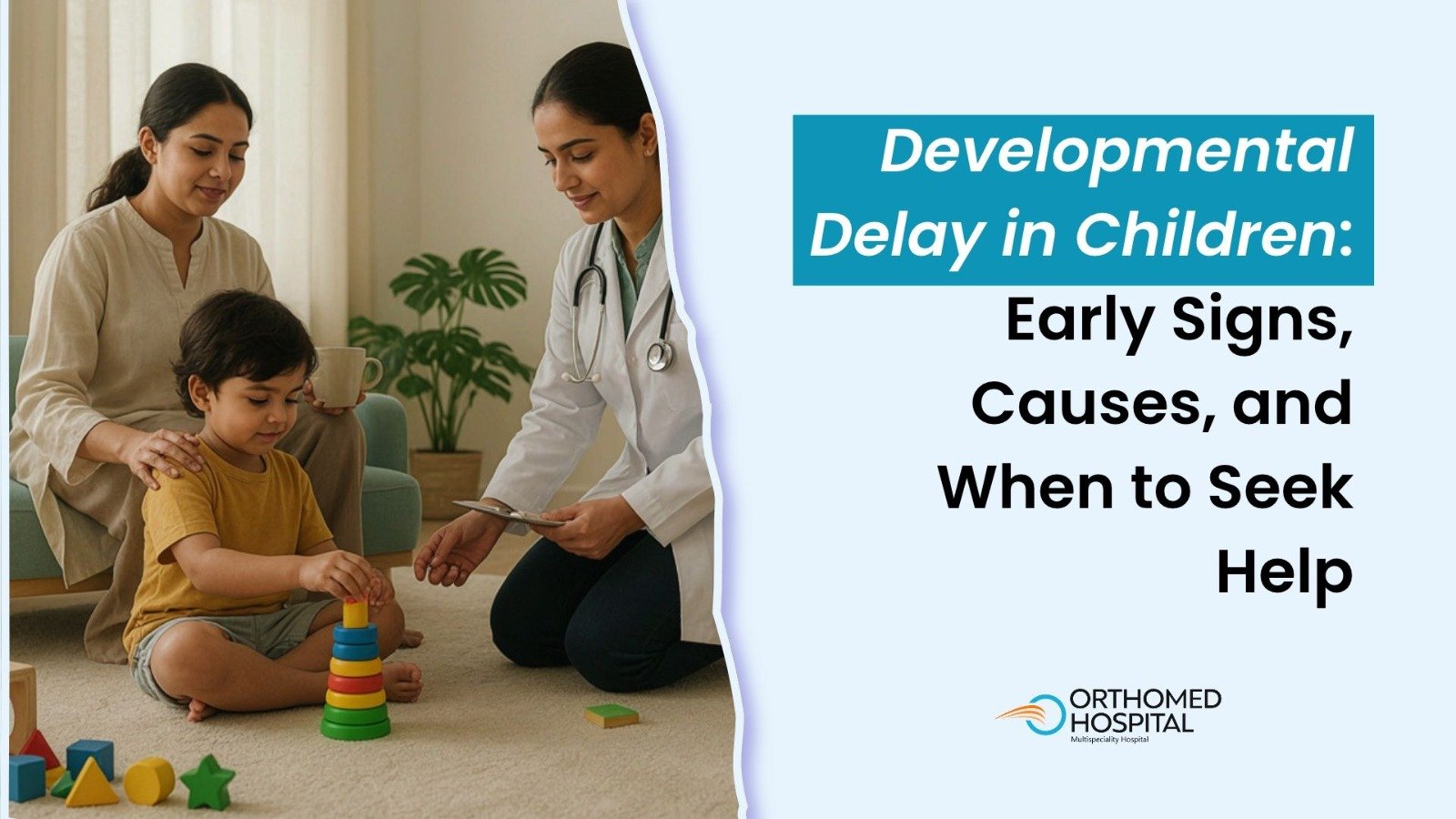
Developmental Delay in Children: Early Signs, Causes, and When to Seek Help
Every parent compares. You see your neighbour’s baby crawling at seven months while yours is still happy rolling around. Your sister’s son was talking in sentences at two, and your daughter is still pointing at things. Then the grandparents weigh in, and suddenly you are not sure whether to worry or relax.
It is normal to wonder. Children grow at their own pace, and a few weeks’ difference in when a child walks or talks usually means nothing. But sometimes a gap in development is a sign that a child needs extra support. Knowing the difference can change the course of a child’s life, because the earlier help begins, the better the outcome.
This guide explains what developmental delay in children really means, the early signs to watch for at different ages, the common causes, and when it is time to consult a child development specialist.
What Is Developmental Delay?
Developmental delay means a child has not reached certain milestones within the expected age range. Milestones are skills most children learn at roughly the same stage, such as smiling, sitting, walking, saying first words, or playing with others.
Doctors usually look at five areas of development:
- Gross motor skills: using large muscles to hold the head up, sit, crawl, walk, run, and jump
- Fine motor skills: using hands and fingers to grasp, pick up small objects, hold a crayon, or button a shirt
- Speech and language: understanding words, babbling, talking, and following instructions
- Social and emotional skills: making eye contact, smiling, responding to people, playing with others
- Cognitive skills: thinking, learning, problem-solving, and remembering
A child may be delayed in one area, such as speech, while doing well in others. When a child is significantly behind in two or more areas, doctors call it global developmental delay.
Developmental delay is a description, not a diagnosis. It tells us a child needs a closer look. Sometimes the delay is mild and the child catches up with a little support. Sometimes it points to an underlying condition such as hearing loss, autism, cerebral palsy, or a genetic disorder that needs specific care.
Child Development Milestones: A Simple Guide
Every child is different, and these are general ranges, not strict deadlines. Use them as a reference, not a test.
By 2 months
- Smiles at people
- Turns towards sounds
- Begins to hold the head up briefly when lying on the tummy
By 4 months
- Holds the head steady without support
- Babbles and coos
- Brings hands to the mouth
- Follows moving objects with the eyes
By 6 months
- Rolls over in both directions
- Responds to their own name
- Reaches for toys
- Laughs and makes sounds back when you talk
By 9 months
- Sits without support
- Picks up small objects with thumb and finger
- Babbles sounds like “mama” and “baba”
- Shows stranger anxiety, clinging to familiar adults
By 12 months
- Pulls to stand, may take a few steps holding furniture
- Waves bye-bye
- Says one or two simple words
- Looks at things you point to
By 18 months
- Walks alone
- Says several single words
- Points to show you something interesting
- Feeds themselves with fingers
By 2 years
- Runs and kicks a ball
- Puts two words together, like “more milk”
- Follows simple instructions
- Copies adults and other children
By 3 years
- Climbs well and pedals a tricycle
- Speaks in short sentences that strangers mostly understand
- Plays pretend
- Shows affection and takes turns in games
If your child is a little behind on one milestone but moving forward steadily, that is usually reassuring. What matters most is progress over time, not a single date on a chart.
Early Signs of Developmental Delay
The early signs of developmental delay can be subtle in the first year and become clearer as the child grows. Here are the signs, by age, that are worth discussing with a doctor.
In babies (0 to 12 months)
- Does not smile at people by 3 months
- Does not respond to loud sounds
- Does not follow objects with the eyes
- Very floppy or very stiff body
- Cannot hold the head up by 4 to 5 months
- Does not reach for or hold toys by 6 months
- Does not roll over by 6 to 7 months
- Cannot sit without support by 9 months
- No babbling by 9 to 10 months
- Does not respond to their name by 12 months
Developmental delay symptoms in toddlers (1 to 3 years)
- Not walking by 18 months
- No single words by 16 months
- No two-word phrases by 2 years
- Does not point to show things
- Does not understand simple instructions like “give me the ball”
- Little interest in other children or people
- Poor eye contact
- Repetitive movements like hand flapping or rocking
- Walks only on toes
- Frequent falls or clumsiness beyond what is typical
- Does not play pretend by 3 years
At any age
One sign needs attention straight away, no matter how old the child is: losing skills they already had. If a child who used to say words stops talking, or a child who was walking starts crawling again, see a doctor promptly. Regression is never something to wait out.
Causes of Developmental Delay in Children
Parents often ask, “Did I do something wrong?” In most cases, the answer is no. The causes of developmental delay in children are varied, and many are outside anyone’s control. In some children, no specific cause is ever found.
Common causes and risk factors include:
Before birth
- Genetic conditions such as Down syndrome or Fragile X syndrome
- Infections during pregnancy, such as rubella or cytomegalovirus
- Exposure to alcohol, tobacco, or certain medicines during pregnancy
- Poor nutrition or uncontrolled health conditions in the mother
Around birth
- Premature birth, especially before 32 weeks
- Low birth weight
- Lack of oxygen during delivery
- Severe jaundice in the newborn period that was not treated in time
After birth
- Hearing problems, which can delay speech even when everything else is normal
- Vision problems
- Thyroid problems, which is why newborn thyroid screening matters
- Serious infections such as meningitis
- Head injuries
- Iron deficiency anaemia and poor nutrition
- Lead exposure
- Limited stimulation, play, or interaction at home
Conditions linked with delay
- Autism spectrum disorder
- Cerebral palsy
- Intellectual disability
- Muscular conditions
Limited stimulation deserves a closer look, because screen time has become a real concern. Many busy parents hand a toddler a phone at mealtimes. Paediatricians increasingly see speech delays in young children who spend hours on screens and little time in real conversation. Swapping some of that screen time for talking, singing, and play can make a real difference.
Why Early Help Makes Such a Difference
A child’s brain develops faster in the first five years than at any other time. During this window, the brain is highly adaptable. Skills that are hard to build later can be built more easily when a child is very young.
This is why early intervention works so well. A toddler with a speech delay who begins speech therapy at two often makes far better progress than one who starts at five. A baby with low muscle tone who begins physiotherapy early may walk sooner and more steadily.
Waiting to “see if they grow out of it” is understandable, and sometimes children do catch up. But if they don’t, valuable months are lost. Getting an assessment does not commit you to anything. If all is well, you get peace of mind. If your child needs help, you get it at the time it works best.
When to Consult a Child Development Specialist
Trust your instincts. Parents usually notice something is different long before anyone else does. You know your child better than any chart.
Consult a child development specialist or paediatrician if:
- Your child is missing several milestones for their age
- Your child is behind in more than one area of development
- Your child has lost a skill they once had
- Your child does not respond to sounds or their name
- Your child makes little eye contact or does not seem interested in people
- Your child’s speech is much harder to understand than other children of the same age
- Your child was born premature or had complications at birth and you want them monitored
- A teacher or caregiver has raised concerns
- You simply have a feeling that something is not right
Don’t let anyone talk you out of seeking an opinion. “Boys talk late” or “his father also spoke late” may be true in some families, but it is not a reason to skip an assessment.
What Happens During a Developmental Assessment?
The doctor will ask about pregnancy, birth, family history, and the milestones your child has reached. Bring notes, vaccination records, and short videos of your child at home, since children often behave differently in a clinic. The doctor will then play with and observe your child, often using age-specific screening tools.
Depending on the findings, they may suggest hearing and vision tests, blood tests for thyroid and iron levels, genetic tests, or a referral to a speech therapist, occupational therapist, or physiotherapist. The assessment is not something your child passes or fails. It simply shows where they are and what will help.
How Developmental Delay Is Managed
There is no single treatment for developmental delay because every child’s needs are different. The plan is built around the specific areas where the child needs support. It may include:
- Speech and language therapy for delays in talking, understanding, or communicating
- Physiotherapy for motor delays, muscle tone problems, or balance and coordination
- Occupational therapy for fine motor skills, sensory issues, and daily activities like eating and dressing
- Behavioural therapy for children with autism or behaviour challenges
- Special education support as the child begins school
- Medical treatment for underlying causes, such as thyroid medication or hearing aids
Parents are an essential part of therapy. Therapists will show you exercises and activities to do at home, and the time you spend practising with your child often makes the biggest difference.
Simple Ways to Support Your Child’s Development at Home
Whether or not your child has a delay, these everyday habits help all children grow:
- Talk constantly. Describe what you are doing while cooking, bathing, or walking. Name objects, colours, and people.
- Read together every day. Picture books, even for babies, build language and attention.
- Sing songs and rhymes. Traditional Tamil lullabies and rhymes are wonderful for language and rhythm.
- Give tummy time to babies when they are awake, to build neck and shoulder strength.
- Let them play on the floor with safe objects to explore, grab, and move.
- Limit screen time. For children under two, keep screens to a minimum, apart from video calls with family.
- Respond to their attempts to communicate. When your baby babbles, babble back. When your toddler points, name what they are pointing at.
- Encourage play with other children.
- Offer nutritious food, including iron-rich foods like greens, dal, eggs, and ragi.
Paediatric Care at Orthomed Multispeciality Hospital
At Orthomed Multispeciality Hospital in Chennai, our Paediatrics department supports children from birth through adolescence, including regular growth and development check-ups. We also provide vaccination and immunisation services, so routine visits double as an opportunity to track milestones.
When a child needs more support, our multispeciality setup makes it easier to coordinate care across paediatrics, neurology, ENT for hearing concerns, endocrinology for thyroid problems, and physiotherapy, without parents having to run between different hospitals.
Final Thoughts
Developmental delay in children can feel overwhelming to hear about, but it is also one of the areas of medicine where early action makes the clearest difference. Most children with delays make real progress with the right support, and many catch up fully.
You do not need to be certain something is wrong to ask for help. A simple conversation with a doctor can either reassure you or set your child on the right path early.
If you have noticed any of the early signs of developmental delay in your child, book a consultation with the paediatric team at Orthomed Multispeciality Hospital, Chennai. Call us at +91 99400 99992 to schedule a visit.
Comments are closed