
- Home
- About
- Services
- Specialists
- Research
- Achivements
- gallery
- contact




- Home
- About Us
- Orthopedics
- Know Your Alignment
- Sports Medicine
- Knee
- Arthroscopic ACI Cartilage Transplant
- Arthroscopic ACL Avulsion Fixation
- Arthroscopic ACL Primary Repair
- Arthroscopic ACL Reconstruction – All Inside Technique
- Arthroscopic ACL Rehab
- Arthroscopic ACL Revision Surgery
- Arthroscopic ACL Single Bundle Reconstruction
- Arthroscopic assisted MPFL Reconstruction
- Arthroscopic assisted Multiple Ligament Tear – SURGERY
- Arthroscopic Medial Meniscal Repair
- Arthroscopic OATS Chondroplasty
- Arthroscopic OCD Fixation
- Arthroscopic Paediatric ACL Reconstruction
- Arthroscopic PCL Avulsion Fixation
- Arthroscopic PCL Reconstruction
- Arthroscopy Assisted STEM Cell Cartilage Transplant
- PCL Rehabilitation
- Total Knee Replacement
- Shoulder
- Arthroscopic Rotator Cuff Repair
- Arthroscopic Bankart Repair
- Arthroscopy Assisted Latarjet Surgery
- AC Joint Fixation
- Arthroscopic Capsular Release
- Arthroscopic Sub – Acromial Decompression (SAD)
- Arthroscopic Calcific Tendinitis Excision
- Arthroscopic Biceps Tenodesis
- Arthroscopic SLAP Repair
- Arthroscopic Revision Cuff Repair
- Arthroscopic Revision Bankart Repair
- Shoulder Rehab
- Elbow
- Wrist
- Hip
- Ankle
- Our Specialities
- Cardiology
- Gastroenterology
- Radiology
- Internal Medicine & Diabetology
- Anesthesiology & Intensive Care Unit
- Neurology
- Nephrology
- Urology
- Oncology
- Rheumatology
- Endocrinology
- General Surgery
- Laparoscopic Surgery
- Podiatric / Diabetic Foot Clinic
- Obstetrics & Gynecology
- ENT
- Plastic & Cosmetic Surgery
- Paediatrics
- Pulmonology
- Psychiatry
- Vascular Surgery
- Dermatology
- Oral and Maxillofacial Surgery
- Our Services
- Resource
- Enquiry
- Home
- About Us
- Orthopedics
- Know Your Alignment
- Sports Medicine
- Knee
- Arthroscopic ACI Cartilage Transplant
- Arthroscopic ACL Avulsion Fixation
- Arthroscopic ACL Primary Repair
- Arthroscopic ACL Reconstruction – All Inside Technique
- Arthroscopic ACL Rehab
- Arthroscopic ACL Revision Surgery
- Arthroscopic ACL Single Bundle Reconstruction
- Arthroscopic assisted MPFL Reconstruction
- Arthroscopic assisted Multiple Ligament Tear – SURGERY
- Arthroscopic Medial Meniscal Repair
- Arthroscopic OATS Chondroplasty
- Arthroscopic OCD Fixation
- Arthroscopic Paediatric ACL Reconstruction
- Arthroscopic PCL Avulsion Fixation
- Arthroscopic PCL Reconstruction
- Arthroscopy Assisted STEM Cell Cartilage Transplant
- PCL Rehabilitation
- Total Knee Replacement
- Shoulder
- Arthroscopic Rotator Cuff Repair
- Arthroscopic Bankart Repair
- Arthroscopy Assisted Latarjet Surgery
- AC Joint Fixation
- Arthroscopic Capsular Release
- Arthroscopic Sub – Acromial Decompression (SAD)
- Arthroscopic Calcific Tendinitis Excision
- Arthroscopic Biceps Tenodesis
- Arthroscopic SLAP Repair
- Arthroscopic Revision Cuff Repair
- Arthroscopic Revision Bankart Repair
- Shoulder Rehab
- Elbow
- Wrist
- Hip
- Ankle
- Our Specialities
- Cardiology
- Gastroenterology
- Radiology
- Internal Medicine & Diabetology
- Anesthesiology & Intensive Care Unit
- Neurology
- Nephrology
- Urology
- Oncology
- Rheumatology
- Endocrinology
- General Surgery
- Laparoscopic Surgery
- Podiatric / Diabetic Foot Clinic
- Obstetrics & Gynecology
- ENT
- Plastic & Cosmetic Surgery
- Paediatrics
- Pulmonology
- Psychiatry
- Vascular Surgery
- Dermatology
- Oral and Maxillofacial Surgery
- Our Services
- Resource
- Enquiry


- Home
- About Us
- Orthopedics
- Know Your Alignment
- Sports Medicine
- Knee
- Arthroscopic ACI Cartilage Transplant
- Arthroscopic ACL Avulsion Fixation
- Arthroscopic ACL Primary Repair
- Arthroscopic ACL Reconstruction – All Inside Technique
- Arthroscopic ACL Rehab
- Arthroscopic ACL Revision Surgery
- Arthroscopic ACL Single Bundle Reconstruction
- Arthroscopic assisted MPFL Reconstruction
- Arthroscopic assisted Multiple Ligament Tear – SURGERY
- Arthroscopic Medial Meniscal Repair
- Arthroscopic OATS Chondroplasty
- Arthroscopic OCD Fixation
- Arthroscopic Paediatric ACL Reconstruction
- Arthroscopic PCL Avulsion Fixation
- Arthroscopic PCL Reconstruction
- Arthroscopy Assisted STEM Cell Cartilage Transplant
- PCL Rehabilitation
- Total Knee Replacement
- Shoulder
- Arthroscopic Rotator Cuff Repair
- Arthroscopic Bankart Repair
- Arthroscopy Assisted Latarjet Surgery
- AC Joint Fixation
- Arthroscopic Capsular Release
- Arthroscopic Sub – Acromial Decompression (SAD)
- Arthroscopic Calcific Tendinitis Excision
- Arthroscopic Biceps Tenodesis
- Arthroscopic SLAP Repair
- Arthroscopic Revision Cuff Repair
- Arthroscopic Revision Bankart Repair
- Shoulder Rehab
- Elbow
- Wrist
- Hip
- Ankle
- Our Specialities
- Cardiology
- Gastroenterology
- Radiology
- Internal Medicine & Diabetology
- Anesthesiology & Intensive Care Unit
- Neurology
- Nephrology
- Urology
- Oncology
- Rheumatology
- Endocrinology
- General Surgery
- Laparoscopic Surgery
- Podiatric / Diabetic Foot Clinic
- Obstetrics & Gynecology
- ENT
- Plastic & Cosmetic Surgery
- Paediatrics
- Pulmonology
- Psychiatry
- Vascular Surgery
- Dermatology
- Oral and Maxillofacial Surgery
- Our Services
- Resource
- Enquiry
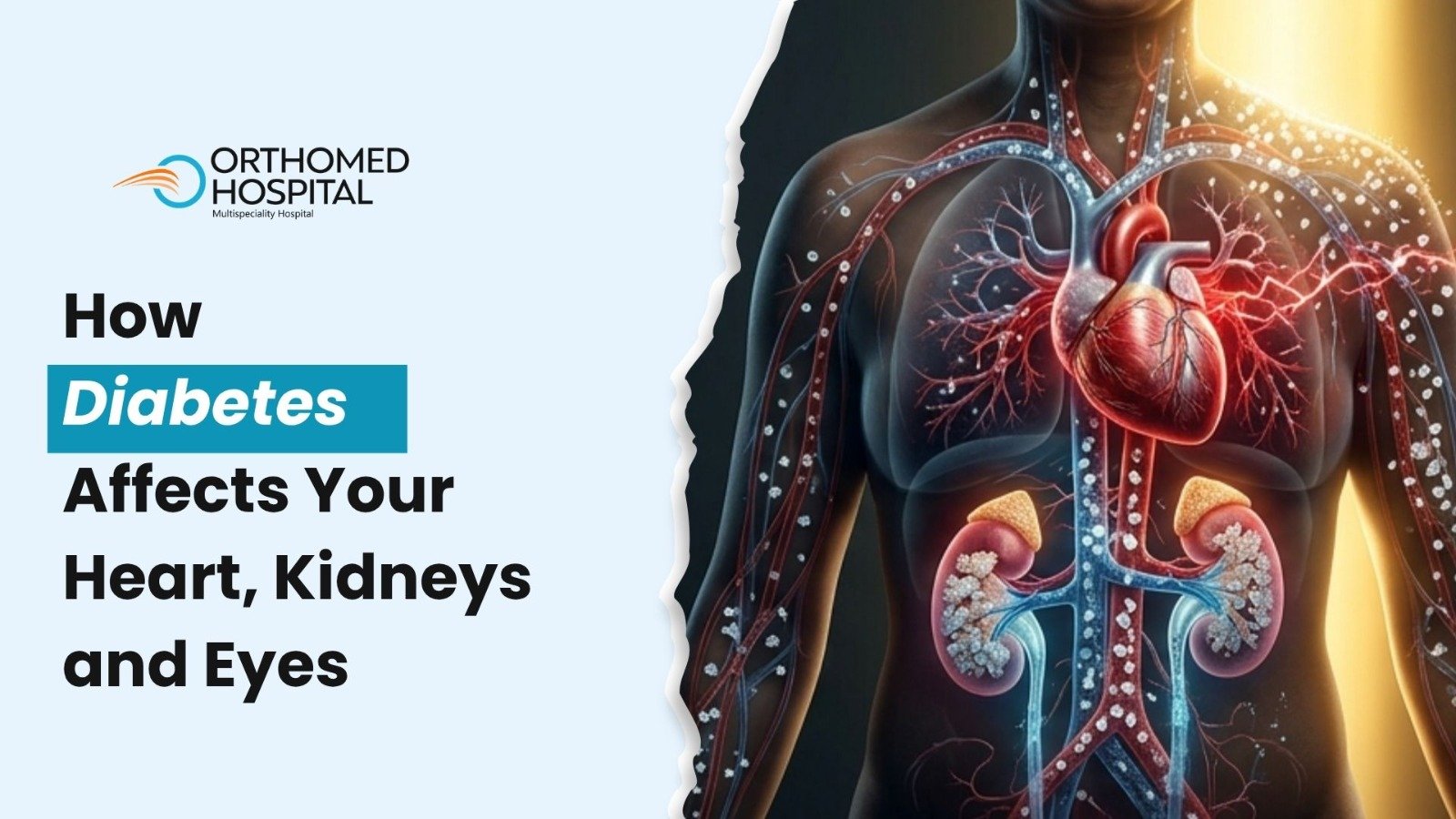
How Diabetes Affects Your Heart, Kidneys and Eyes
When you are first diagnosed with diabetes, the initial focus is almost always on numbers. You learn to track fasting blood sugar, monitor post-meal spikes, and check your HbA1c, a test that measures your average blood sugar levels over the past few months.
But as time goes on, you realize that managing this condition is about much more than a digital reading on a glucometer. Diabetes is a chronic disease that reshapes how your entire body functions. When blood sugar remains consistently high, it acts like a slow, quiet current, gradually wearing away at your blood vessels and nerve pathways.
Over years, this micro-vascular stress can deeply impact three of your body’s most vital systems: your heart, your kidneys, and your eyes.
Understanding this connection is not about living in fear. Instead, it is about recognizing how the choices you make today protect your health tomorrow. By understanding how diabetes complications develop, you can take control of your lifestyle and work alongside specialists to keep your body strong.
1. The Heart Connection: How Diabetes Accelerates Cardiovascular Risks
It is a medical fact that adults with diabetes are twice as likely to develop heart disease or experience a stroke compared to those without it. To understand why, it helps to look at how high blood sugar transforms the internal environment of your blood vessels.
The Mechanics of Vascular Damage
Your blood vessels are lined with a delicate, smooth layer of cells called the endothelium. When blood glucose remains elevated, it triggers inflammation and oxidative stress within these cells. Think of it like sand passing through a delicate pipe; over time, the abrasive environment scratches and damages the smooth lining.
This cellular damage makes it much easier for low-density lipoprotein (LDL, or “bad”) cholesterol to settle into the walls of your arteries. Once inside, the cholesterol oxidizes and forms hard, fatty plaques, a process known as atherosclerosis (hardening of the arteries).
[High Blood Sugar] ➔ [Endothelial Inflammation] ➔ [Cholesterol Accumulation] ➔ [Plaque Buildup] ➔ [Narrowed Arteries]
As plaques build up, your arteries narrow, restricting the free flow of oxygen-rich blood to your heart muscle. If a piece of this plaque ruptures, it can form a sudden blood clot, leading to a heart attack or stroke.
Metabolic Companions: Blood Pressure and Cholesterol
Diabetes rarely travels alone. It frequently brings along two silent partners: hypertension (high blood pressure) and dyslipidemia (unhealthy cholesterol ratios).
- Hypertension: When your insulin levels are unstable, it causes your blood vessels to stiffen and causes your body to retain excess sodium. This forces your heart to pump harder to circulate blood, straining the cardiac muscle.
- Dyslipidemia: Diabetes often creates a specific, hazardous lipid profile: high triglycerides, low HDL (“good”) cholesterol, and dense, highly volatile LDL particles that easily penetrate arterial walls.
Together, this triad, high blood sugar, high blood pressure, and abnormal cholesterol, creates a compounding risk environment for your cardiovascular system.
Recognizing the Warning Signs
Cardiovascular complications can develop quietly, but your body often sends subtle signals when the heart is working under undue stress:
- Unexplained shortness of breath, especially during mild physical exertion like climbing stairs.
- A heavy, squeezing sensation, tightness, or dull ache in your chest that may radiate to your jaw, neck, back, or left arm.
- Chronic, profound fatigue that rest doesn’t seem to fix.
- Sudden dizziness, lightheadedness, or cold sweats.
Because nerve damage from diabetes can sometimes blunt your perception of pain, cardiac events can present with non-traditional symptoms, such as severe indigestion or sudden weakness. Paying close attention to changes in your physical stamina is essential.
2. Silent Strain on the Kidneys: The Path to Diabetic Nephropathy
Your kidneys are your body’s built-in filtration plant. Every single day, they process gallons of blood, sifting out cellular waste, toxins, and excess fluids while keeping crucial proteins and nutrients safely inside your bloodstream. This delicate balance is maintained by millions of microscopic structures called nephrons.
When a person navigates a long-term chronic disease like diabetes, these delicate filtering units face immense structural pressure.
The Filter Breakdown
Inside each nephron sits a tiny cluster of looping blood vessels called a glomerulus. These vessels are incredibly fine and highly sensitive to changes in chemical balance and pressure.
[Chronic High Glucose] ➔ [Increased Glomerular Pressure] ➔ [Filter Leaks Protein] ➔ [Scar Tissue Forms]
When blood thick with glucose continuously passes through these micro-filters, it causes them to dilate and shifts the internal fluid pressures. Over time, the physical stress causes the filters to thicken and scar.
As the structural integrity of the glomerulus degrades, it begins to leak. In the early stages of damage, tiny amounts of a vital protein called albumin slip through the damaged barrier and escape into your urine. This condition is known as microalbuminuria. If left unchecked, the filtration system deteriorates further, eventually leading to advanced kidney strain or chronic kidney disease (CKD).
The Challenge of Early Detection
The most complex part of kidney strain, medically termed diabetic nephropathy, is that it causes no physical pain or visible symptoms in its initial years. Your kidneys are remarkably resilient and will work overtime to compensate for damaged areas, masking the underlying issue until the decline is significant.
As kidney function decreases substantially, waste products begin to accumulate in the bloodstream, leading to visible physical changes:
- Edema: Fluid retention that causes noticeable swelling in your feet, ankles, hands, or around your eyes.
- Changes in Urination: Urine that appears unusually foamy or bubbly (a direct sign of heavy protein leakage), or an increase in the frequency of urination, particularly at night.
- Systemic Uremia: As toxins build up, you may experience persistent nausea, a metallic taste in your mouth, a loss of appetite, or intense, widespread skin itching.
Catching these changes early requires regular, proactive laboratory screenings, including a urine albumin-to-creatinine ratio (UACR) and a blood test to measure your Estimated Glomerular Filtration Rate (eGFR).
3. Protecting Your Vision: Managing Diabetic Retinopathy
Your eyes are incredibly vascular organs, meaning they rely on a dense, complex network of microscopic blood vessels to feed the tissues that grant you sight. The most vulnerable of these tissues is the retina, the light-sensitive layer at the back of your eye that acts like the canvas capturing the visual world.
The Stages of Retinal Alteration
When high blood sugar alters your systemic circulation, the tiny, fragile vessels supplying the retina are often the first to feel the impact. This progression generally unfolds across two primary phases:
1. Non-Proliferative Diabetic Retinopathy (NPDR)
In this early stage, high glucose weakens the structural walls of the retinal capillaries. These weakened walls form tiny, balloon-like bulges called microaneurysms.
As the structural walls degrade, these micro-vessels can leak fluid, fats, and small amounts of blood directly into the retinal tissue. If this fluid collects in the center of your vision the macula it causes swelling known as macular edema, which makes reading, driving, or recognizing faces difficult.
2. Proliferative Diabetic Retinopathy (PDR)
As more vessels become blocked, large areas of the retina are deprived of oxygen and nutrients. In a desperate attempt to restore circulation, the retina releases chemical signals to trigger the growth of new blood vessels.
However, these new vessels are structurally flawed, weak, and highly unstable. They grow along the surface of the retina and into the clear, gel-like fluid filling the center of your eye (the vitreous). Because they are so fragile, they can rupture and bleed easily, clouding your vision with floating spots or, in severe cases, blocking your eyesight completely. Over time, the scar tissue from these leaky vessels can pull away at the retina, leading to a retinal detachment.
Subtle and Sudden Visual Transitions
In its earliest phases, diabetic retinopathy can develop without changing your vision at all. You might look in the mirror, read a book, or drive down the street with perfect clarity, completely unaware of the structural changes occurring at the back of your eye.
As the condition advances, visual disruptions can manifest in several ways:
- Floaters: The sudden appearance of dark spots, thin cobweb-like lines, or floating streaks across your field of view.
- Fluctuating Vision: Clear vision in the morning that grows blurry by afternoon, often tied directly to shifts in your daily blood sugar levels.
- Distorted Fields: Dark, blank patches, a washed-out appearance to colors, or difficulty seeing clearly in low-light environments.
Because these changes can happen gradually or occur outside your central line of vision, waiting for symptoms to appear before booking an exam is a significant risk. Annual, dilated eye evaluations allow specialists to view the back of your eye directly, catching capillary changes long before they threaten your sight.
4. The Path to Prevention: Comprehensive Diabetes Management
Living with diabetes means adjusting your focus from short-term corrections to long-term stability. While the risk of complications is a reality of the condition, your body possesses an incredible capacity for resilience when provided with steady, consistent support.
Effective diabetes management is built on a foundation of daily choices, medical partnership, and targeted screenings.
Daily Lifestyle Interventions
Small, deliberate actions taken every day can fundamentally change how glucose interacts with your vascular system.
Nutritional Alignment
Shifting your diet isn’t about restriction; it’s about introducing balance. Focus on meals rich in soluble fiber such as whole grains, legumes, leafy greens, and vegetables which slow the absorption of sugar into your bloodstream, preventing steep post-meal spikes. Pairing complex carbohydrates with lean proteins and healthy fats (like avocados, nuts, and olive oil) helps maintain stable energy levels and reduces inflammatory stress on your blood vessels.
Functional Movement
Regular physical activity acts as a natural booster for your metabolism. When you engage in moderate exercise like a 30-minute brisk walk, swimming, or cycling your muscles pull glucose directly from your bloodstream to use for energy, even if your body is struggling with insulin resistance. Aim for at least 150 minutes of moderate movement per week, spread across several days, to help lower both your average blood sugar and your resting blood pressure.
Stress and Sleep Balance
When your body is chronically stressed or sleep-deprived, it releases elevated levels of hormones like cortisol and adrenaline. These hormones naturally signal your liver to release stored glucose into your blood, raising your overall levels. Prioritizing 7 to 8 hours of restorative sleep and practicing simple relaxation techniques can make managing your daily blood sugar significantly smoother.
Essential Screening Protocols
Staying ahead of complications requires tracking specific health markers at regular intervals. Keeping a record of these key metrics provides a clear map of your vascular health:
Screening Type | Recommended Frequency | Targeted Metric / Health Goal |
HbA1c Blood Test | Every 3 to 6 Months | A broad look at your average blood sugar; typically aiming for under 7% for most adults. |
Blood Pressure Check | Every Medical Visit | Protecting delicate arterial linings; general target is below 130/80 mmHg. |
Lipid Profile (Cholesterol) | Annually | Tracking LDL, HDL, and triglycerides to minimize plaque risk in your arteries. |
Kidney Function Screen | Annually | A combined urine test (UACR) and blood test (eGFR) to evaluate filtration health. |
Comprehensive Eye Exam | Annually | A dilated eye evaluation to check retinal capillaries before vision shifts. |
Comprehensive Foot Exam | Every Medical Visit / Annually | Checking circulation, nerve reflexes, and skin integrity to prevent non-healing wounds. |
5. Finding Comprehensive Care in Chennai
When managing a systemic condition like diabetes, trying to coordinate your care across separate clinics and far-flung specialists can feel overwhelming. True peace of mind comes from having a dedicated medical home where your primary care, heart health, metabolic tracking, and specialty evaluations are handled under one roof.
For families seeking advanced, compassionate diabetes care in Chennai, Orthomed Multi Speciality Hospital provides a fully integrated medical environment. Located in the heart of Royapettah, Orthomed has expanded from its foundations in specialized medicine into a trusted multi-specialty institution, offering comprehensive diagnostic, therapeutic, and preventive services designed to protect your long-term health.
Our Department of Internal Medicine & Diabetology brings together experienced physicians and diabetologists who look past individual test numbers to focus on the person behind the diagnosis.
[Orthomed Hospital Integrated Care]
├── Diabetology & Insulin Optimization
├── Cardiovascular Risk Screening
├── Nephrology & Kidney Care Services
└── Specialized Diabetic Podiatry Clinic
Because diabetes affects multiple organ networks simultaneously, our medical team collaborates across specialties. For individuals navigating advanced filtration challenges, our dedicated nephrology resources function as an expert kidney care hospital ecosystem right within the facility. We provide targeted tracking, precise fluid management, and therapeutic interventions to protect kidney tissue and arrest the progression of nephropathy.
Additionally, our specialized Podiatric & Diabetic Foot Clinic addresses one of the most critical, yet frequently overlooked, complications of diabetes: nerve and circulatory changes in the lower extremities. By combining advanced wound-care technologies with preventive nerve screenings, we work diligently to prevent infections and preserve long-term mobility.
Whether you need to optimize an insulin regimen, screen your cardiovascular risks, or establish a protective, long-term monitoring routine, the medical team at Orthomed Hospital is here to support you at every step.
Your Steps Moving Forward
Discovering how diabetes affects your heart, kidneys, and eyes shouldn’t feel discouraging. Instead, let this knowledge give you a clear sense of direction. Your blood vessels are dynamic, living systems, and even modest improvements in your blood sugar, blood pressure, and daily habits can slow, halt, or even reverse early signs of strain.
Take charge of your wellness by keeping up with your scheduled screenings, making nourishing choices for your body, and partnering with a healthcare team that understands the complete picture of metabolic health.
If you or a loved one are looking for guidance on managing diabetes or want to schedule a comprehensive health check-up, connect with our specialists at Orthomed Multi Speciality Hospital today. Your health is worth a proactive choice.
Comments are closed