
- Home
- About
- Services
- Specialists
- Research
- Achivements
- gallery
- contact




- Home
- About Us
- Orthopedics
- Know Your Alignment
- Sports Medicine
- Knee
- Arthroscopic ACI Cartilage Transplant
- Arthroscopic ACL Avulsion Fixation
- Arthroscopic ACL Primary Repair
- Arthroscopic ACL Reconstruction – All Inside Technique
- Arthroscopic ACL Rehab
- Arthroscopic ACL Revision Surgery
- Arthroscopic ACL Single Bundle Reconstruction
- Arthroscopic assisted MPFL Reconstruction
- Arthroscopic assisted Multiple Ligament Tear – SURGERY
- Arthroscopic Medial Meniscal Repair
- Arthroscopic OATS Chondroplasty
- Arthroscopic OCD Fixation
- Arthroscopic Paediatric ACL Reconstruction
- Arthroscopic PCL Avulsion Fixation
- Arthroscopic PCL Reconstruction
- Arthroscopy Assisted STEM Cell Cartilage Transplant
- PCL Rehabilitation
- Total Knee Replacement
- Shoulder
- Arthroscopic Rotator Cuff Repair
- Arthroscopic Bankart Repair
- Arthroscopy Assisted Latarjet Surgery
- AC Joint Fixation
- Arthroscopic Capsular Release
- Arthroscopic Sub – Acromial Decompression (SAD)
- Arthroscopic Calcific Tendinitis Excision
- Arthroscopic Biceps Tenodesis
- Arthroscopic SLAP Repair
- Arthroscopic Revision Cuff Repair
- Arthroscopic Revision Bankart Repair
- Shoulder Rehab
- Elbow
- Wrist
- Hip
- Ankle
- Our Specialities
- Cardiology
- Gastroenterology
- Radiology
- Internal Medicine & Diabetology
- Anesthesiology & Intensive Care Unit
- Neurology
- Nephrology
- Urology
- Oncology
- Rheumatology
- Endocrinology
- General Surgery
- Laparoscopic Surgery
- Podiatric / Diabetic Foot Clinic
- Obstetrics & Gynecology
- ENT
- Plastic & Cosmetic Surgery
- Paediatrics
- Pulmonology
- Psychiatry
- Vascular Surgery
- Dermatology
- Oral and Maxillofacial Surgery
- Our Services
- Resource
- Enquiry
- Home
- About Us
- Orthopedics
- Know Your Alignment
- Sports Medicine
- Knee
- Arthroscopic ACI Cartilage Transplant
- Arthroscopic ACL Avulsion Fixation
- Arthroscopic ACL Primary Repair
- Arthroscopic ACL Reconstruction – All Inside Technique
- Arthroscopic ACL Rehab
- Arthroscopic ACL Revision Surgery
- Arthroscopic ACL Single Bundle Reconstruction
- Arthroscopic assisted MPFL Reconstruction
- Arthroscopic assisted Multiple Ligament Tear – SURGERY
- Arthroscopic Medial Meniscal Repair
- Arthroscopic OATS Chondroplasty
- Arthroscopic OCD Fixation
- Arthroscopic Paediatric ACL Reconstruction
- Arthroscopic PCL Avulsion Fixation
- Arthroscopic PCL Reconstruction
- Arthroscopy Assisted STEM Cell Cartilage Transplant
- PCL Rehabilitation
- Total Knee Replacement
- Shoulder
- Arthroscopic Rotator Cuff Repair
- Arthroscopic Bankart Repair
- Arthroscopy Assisted Latarjet Surgery
- AC Joint Fixation
- Arthroscopic Capsular Release
- Arthroscopic Sub – Acromial Decompression (SAD)
- Arthroscopic Calcific Tendinitis Excision
- Arthroscopic Biceps Tenodesis
- Arthroscopic SLAP Repair
- Arthroscopic Revision Cuff Repair
- Arthroscopic Revision Bankart Repair
- Shoulder Rehab
- Elbow
- Wrist
- Hip
- Ankle
- Our Specialities
- Cardiology
- Gastroenterology
- Radiology
- Internal Medicine & Diabetology
- Anesthesiology & Intensive Care Unit
- Neurology
- Nephrology
- Urology
- Oncology
- Rheumatology
- Endocrinology
- General Surgery
- Laparoscopic Surgery
- Podiatric / Diabetic Foot Clinic
- Obstetrics & Gynecology
- ENT
- Plastic & Cosmetic Surgery
- Paediatrics
- Pulmonology
- Psychiatry
- Vascular Surgery
- Dermatology
- Oral and Maxillofacial Surgery
- Our Services
- Resource
- Enquiry


- Home
- About Us
- Orthopedics
- Know Your Alignment
- Sports Medicine
- Knee
- Arthroscopic ACI Cartilage Transplant
- Arthroscopic ACL Avulsion Fixation
- Arthroscopic ACL Primary Repair
- Arthroscopic ACL Reconstruction – All Inside Technique
- Arthroscopic ACL Rehab
- Arthroscopic ACL Revision Surgery
- Arthroscopic ACL Single Bundle Reconstruction
- Arthroscopic assisted MPFL Reconstruction
- Arthroscopic assisted Multiple Ligament Tear – SURGERY
- Arthroscopic Medial Meniscal Repair
- Arthroscopic OATS Chondroplasty
- Arthroscopic OCD Fixation
- Arthroscopic Paediatric ACL Reconstruction
- Arthroscopic PCL Avulsion Fixation
- Arthroscopic PCL Reconstruction
- Arthroscopy Assisted STEM Cell Cartilage Transplant
- PCL Rehabilitation
- Total Knee Replacement
- Shoulder
- Arthroscopic Rotator Cuff Repair
- Arthroscopic Bankart Repair
- Arthroscopy Assisted Latarjet Surgery
- AC Joint Fixation
- Arthroscopic Capsular Release
- Arthroscopic Sub – Acromial Decompression (SAD)
- Arthroscopic Calcific Tendinitis Excision
- Arthroscopic Biceps Tenodesis
- Arthroscopic SLAP Repair
- Arthroscopic Revision Cuff Repair
- Arthroscopic Revision Bankart Repair
- Shoulder Rehab
- Elbow
- Wrist
- Hip
- Ankle
- Our Specialities
- Cardiology
- Gastroenterology
- Radiology
- Internal Medicine & Diabetology
- Anesthesiology & Intensive Care Unit
- Neurology
- Nephrology
- Urology
- Oncology
- Rheumatology
- Endocrinology
- General Surgery
- Laparoscopic Surgery
- Podiatric / Diabetic Foot Clinic
- Obstetrics & Gynecology
- ENT
- Plastic & Cosmetic Surgery
- Paediatrics
- Pulmonology
- Psychiatry
- Vascular Surgery
- Dermatology
- Oral and Maxillofacial Surgery
- Our Services
- Resource
- Enquiry
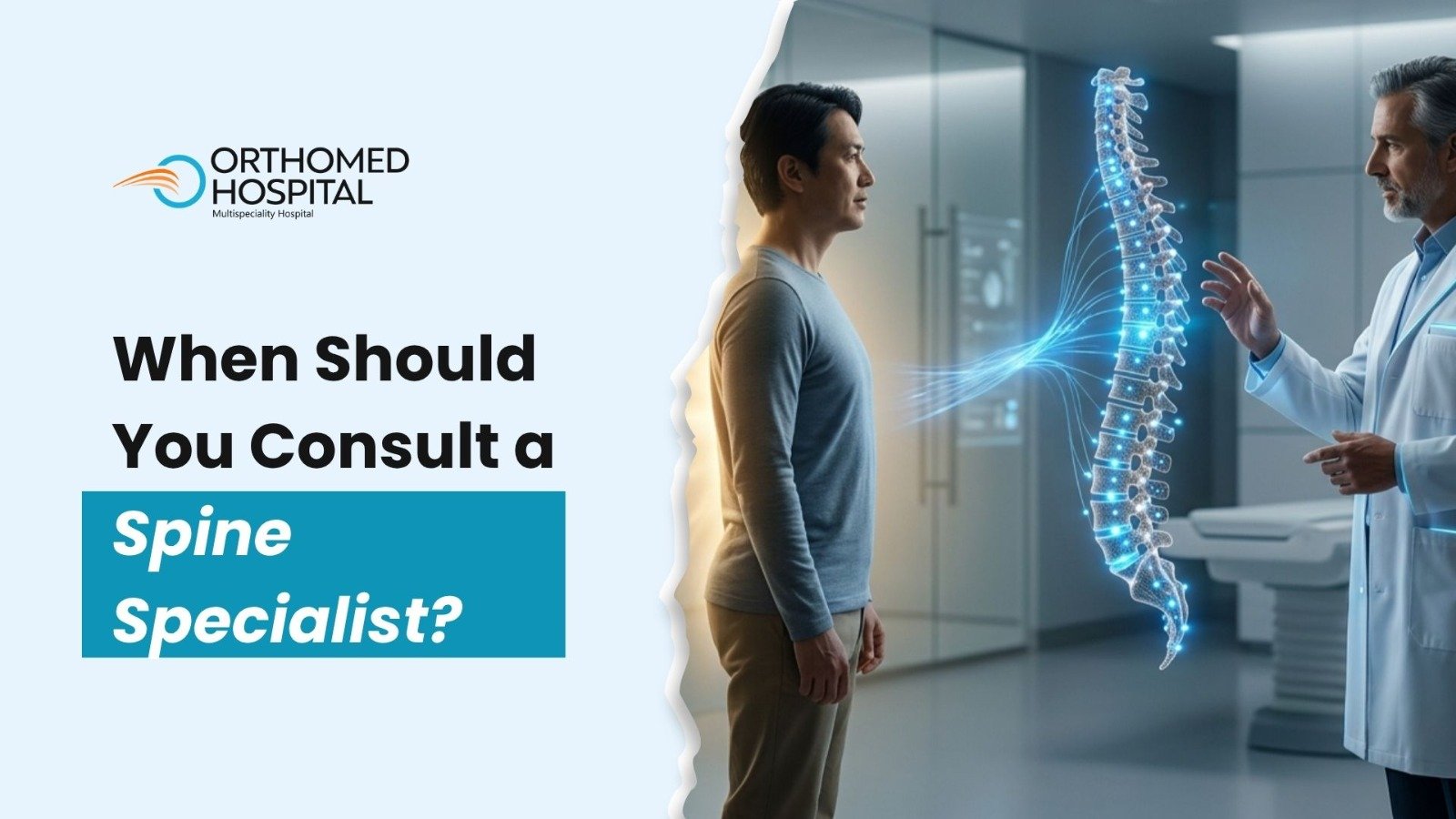
Listening to Your Body: When Should You Consult a Spine Specialist?
We have all been there. You bend down to pick up a dropped set of keys, tie your shoes, or lift a grocery bag, and suddenly, it hits you: a sharp, sudden twinge or a dull, deep ache right in your lower back. Your first instinct might be to ignore it, reach for an over-the-counter pain reliever, and hope a good night’s sleep fixes everything. For standard, everyday muscle fatigue, that often works. But what happens when the pain stays? What happens when it spreads, grows more intense, or starts dictating how you live your life?
Back pain is one of the most common physical ailments humans experience. In fact, global healthcare statistics regularly show that roughly 80% of adults will experience back problems at some point in their lives. Yet, despite how widespread it is, knowing when your discomfort is a temporary nuisance versus a sign of something deeper can be incredibly confusing.
The human spine is a masterpiece of biological engineering, acting as the structural pillar of your body and the protective conduit for your central nervous system. Because it is so complex, managing lingering issues requires precision. While a general practitioner or a physical therapist is excellent for initial, everyday aches, there comes a point where specialized expertise is required.
Let’s cut through the medical jargon and explore exactly when it’s time to book an appointment with a spine specialist, what your symptoms might be trying to tell you, and how dedicated orthopedic spine care can help you reclaim a pain-free life.
Anatomy of the Issue: Understanding Your Spine
Before looking into the warning signs, it helps to understand exactly what we are dealing with. Your spine isn’t just a single bone; it’s a dynamic, interconnected column made up of vertebrae (bones), discs (the rubbery shock absorbers between the bones), muscles, ligaments, and highly sensitive nerves.
As shown in the anatomical structure above, the spine is divided into major sections: the Cervical spine (neck), the Thoracic spine (mid-back), and the Lumbar spine (lower back), terminating at the Sacral and Coccyx regions. Because the lumbar spine carries the vast majority of your body weight and absorbs the impact of twisting, lifting, and bending, it is frequently the primary source of chronic discomfort.
When any single component of this system, whether it’s a slipped disc in the lumbar region, a narrowed spinal canal in the cervical region, or a strained ligament, gets compromised, it can disrupt the balance of the entire structure. That is why professional diagnostic care at an experienced ortho care hospital is so vital to figuring out exactly what is going wrong beneath the surface.
1. The Timeline of Pain: Acute vs. Chronic
The first and most reliable metric you can use to evaluate your back pain is time.
- Acute Pain: This is sudden pain that typically occurs right after a minor injury, a sudden twist, or unaccustomed physical labor (like spending a weekend moving heavy furniture). Acute pain can feel agonizingly sharp initially, but it generally subsides over a few days or weeks as the soft tissues heal.
- Chronic Pain: This is pain that persists for 12 weeks or longer, even after an initial injury or underlying cause has been treated.
If you have been managing persistent discomfort for more than three months, it is no longer just a stubborn muscle strain. Chronic pain often points to structural issues, such as degenerative disc disease, facet joint arthritis, or spinal stenosis. Continuing to treat chronic conditions with temporary band-aids like ice packs and anti-inflammatory medications can lead to long-term compensations in how you walk or sit, which can actually cause secondary joint pain in your hips and knees.
Visiting a specialized orthopedic hospital for thorough imaging and evaluation ensures you target the actual root cause, rather than just masking the ongoing symptoms.
2. Red Flag Symptoms: When to Seek Immediate Care
While many spinal issues can be evaluated through a regularly scheduled appointment, certain symptoms demand immediate medical intervention. These are known as red flags, signaling that a nerve or the spinal cord itself is experiencing severe compression that could lead to permanent damage if left untreated.
Go to an emergency room or consult a specialist immediately if your back pain is accompanied by any of the following:
Loss of Bowel or Bladder Control
This is a hallmark sign of a medical emergency known as Cauda Equina Syndrome. It occurs when the bundle of nerve roots at the lower end of the spinal cord becomes severely compressed. Aside from incontinence, it may present as saddle anesthesia, which is a pronounced numbness in the areas of your body that would touch a riding saddle (the inner thighs, groin, and buttocks).
“Drop Foot” or Sudden Weakness
If you suddenly find yourself tripping over your own feet because you cannot properly lift the front part of your foot when you walk, this is a clear sign of significant motor nerve compromise. Sudden weakness in your leg, knee, or foot means the electrical signals from your brain are being physically blocked from reaching your muscles.
Unexplained Weight Loss or Fever
If your back pain is accompanied by a persistent low-grade fever or significant weight loss that you aren’t actively trying to achieve, it could indicate an underlying spinal infection or, in rarer cases, a tumor.
3. The Pain Traveled: Radiating Symptoms and Sciatica
True spinal issues rarely stay perfectly localized in the back. Because your spinal column houses the main neural highway of the entire body, structural problems in the bones or discs frequently pinch or irritate the nerves branching out to your limbs.
[Spinal Nerve Compression]
│
▼
[Inflammation of the Sciatic Nerve]
│
▼
[Radiating Pain: Buttock ➔ Thigh ➔ Calf ➔ Foot]
If your back discomfort is accompanied by any of the following sensations in your legs or arms, a specialist can help determine the underlying cause:
- Shooting, Electric Pain: A sharp pain that shoots down your buttock, through the back of your thigh, and down into your calf or foot is commonly known as sciatica. This is usually caused by a herniated disc pressing firmly against the sciatic nerve root.
- Numbness and Tingling: A constant “pins and needles” sensation or localized numbness in your fingers, toes, or leg indicates that a nerve’s sensory pathways are being constricted.
- Pain That Changes with Posture: If your pain gets significantly worse when you sit down but feels better when you walk, or conversely, if you find yourself leaning forward on a shopping cart to relieve leg pain while walking (a classic sign of spinal stenosis), your posture is physically shifting your spinal alignment to avoid nerve pressure. A targeted back pain treatment plan can help address these specific structural shifts.
4. Conservative Treatments Have Failed
When you first experience back trouble, the standard advice is to rest briefly, apply heat or ice, gently stretch, and perhaps undergo a few weeks of physical therapy. For a vast majority of minor injuries, this conservative approach works wonders.
However, if you have faithfully completed 4 to 6 weeks of dedicated physical therapy, tried targeted chiropractic adjustments, modified your daily activities, and still find yourself in daily pain, it is time to elevate your care.
A spine specialist looks at your body through a highly refined lens. When conservative therapies stall, they can offer advanced diagnostic techniques, such as high-resolution MRIs, CT scans, or diagnostic nerve blocks, to locate the precise tissue causing the problem. Moving past basic care doesn’t mean you are jumping straight onto an operating table; rather, it opens the door to more precise, non-surgical options like epidural steroid injections, radiofrequency ablation, or advanced regenerative medicine.
What to Expect: Orthopedic Spine Care vs. General Medicine
A common question people ask when navigating joint or back pain is: “Why can’t my regular family doctor just handle this?”
Your primary care doctor is the quarterback of your overall health, highly capable of treating systemic issues and initial strains. However, an orthopedic hospital focuses entirely on the musculoskeletal system. A dedicated spine program brings together orthopedic surgeons, neurosurgeons, interventional pain management physicians, and specialized physical therapists who focus on spinal care day in and day out.
General Practitioner | Spine Specialist (Orthopedic Spine Care) |
Focuses on systemic wellness, routine health checks, and initial pain triage. | Focuses strictly on disorders of the vertebrae, discs, and spinal nerves. |
Prescribes basic oral anti-inflammatories, muscle relaxers, and general rest. | Provides advanced diagnostics, targeted injections, and minimally invasive interventions. |
Refers out when standard symptoms persist beyond a few weeks. | Coordinates specialized long-term rehabilitation and advanced surgical options if needed. |
When you choose a specialized facility like Orthomed Hospital, your treatment pathway is built around preserving your long-term mobility. The goal of modern orthopedic spine care is always to find the most conservative, least invasive route to long-term relief.
Debunking the Big Myth: “Seeing a Spine Specialist Means Surgery”
The single biggest reason people delay scheduling a consultation with a specialist is fear. There is a deeply ingrained myth that walking into an orthopedic clinic means you will automatically walk out with a scheduled date for major spinal surgery.
This could not be further from the truth.
In reality, reputable specialists view surgery as a definitive last resort, reserved for cases where structural instability or progressive nerve damage threatens your permanent mobility. Upwards of 90% of patients who visit a dedicated spine center are successfully treated using a combination of:
- Interventional Pain Management: Image-guided injections that deliver anti-inflammatory medication directly to the irritated nerve root or facet joint, breaking the cycle of chronic inflammation.
- Advanced Physical Therapy: Highly customized core-stabilization and mechanical diagnosis therapies designed to strengthen the supporting muscles around your spine, naturally reducing the physical load on your vertebrae.
- Lifestyle and Ergonomic Modifications: Using bio-mechanical feedback to alter how you sit, stand, lift, and move during your workday to protect your spine from repetitive strain injuries.
If surgery does become necessary due to severe structural issues, modern advancements mean that procedures are vastly different than they were a generation ago. Many procedures are now performed using minimally invasive spine surgery (MISS) techniques. These methods utilize tiny incisions, microscopic cameras, and specialized instruments that allow surgeons to treat herniated discs or stabilize joints without disrupting the surrounding healthy muscle tissue. This results in significantly less postoperative pain, shorter hospital stays, and a much faster return to your normal life.
Simple Everyday Steps to Protect Your Spine
While knowing when to seek professional help is essential, practicing daily spine-healthy habits can help prevent minor issues from escalating into chronic conditions.
- Prioritize Core Strength: Your abdomen and lower back muscles act as a natural internal corset for your spine. Strengthening these muscles through low-impact exercises like swimming, planks, or supervised yoga provides crucial structural support to your lower back.
- Mind Your Ergonomics: If you work at a desk, ensure your computer monitor is at eye level so you don’t constantly tilt your neck forward. Keep your feet flat on the floor, and use a chair that supports the natural curve of your lower back.
- Stay Hydrated: Your spinal discs are composed largely of water. Staying consistently hydrated throughout the day helps keep these essential cushions pliable and resilient against daily physical impacts.
- Move Every Hour: The human body wasn’t designed for prolonged static postures. Set a simple timer to stand up, gently stretch, and walk around for two to three minutes for every hour you spend sitting down.
Conclusion: Take Action for Your Long-Term Health
Your spine is the foundation of your daily movement, physical independence, and overall quality of life. Lingering back pain isn’t just a physical inconvenience; it drains your mental energy, limits your time with family, and keeps you from doing the things you love.
If you are tired of living around your back discomfort, remember that you don’t have to navigate it alone. Whether you need a precise diagnostic assessment, specialized physical therapy, or an advanced back pain treatment plan, specialized care can help you find lasting relief.
Listen to what your body is trying to tell you. If your back or neck pain has lasted for months, travels down your limbs, or keeps you up at night, take a proactive step forward. Schedule a full evaluation at a dedicated ortho care hospital like Orthomed Hospital to uncover the root cause of your pain and start your journey back to smooth, comfortable, and confident movement.
Comments are closed