
- Home
- About
- Services
- Specialists
- Research
- Achivements
- gallery
- contact




- Home
- About Us
- Orthopedics
- Know Your Alignment
- Sports Medicine
- Knee
- Arthroscopic ACI Cartilage Transplant
- Arthroscopic ACL Avulsion Fixation
- Arthroscopic ACL Primary Repair
- Arthroscopic ACL Reconstruction – All Inside Technique
- Arthroscopic ACL Rehab
- Arthroscopic ACL Revision Surgery
- Arthroscopic ACL Single Bundle Reconstruction
- Arthroscopic assisted MPFL Reconstruction
- Arthroscopic assisted Multiple Ligament Tear – SURGERY
- Arthroscopic Medial Meniscal Repair
- Arthroscopic OATS Chondroplasty
- Arthroscopic OCD Fixation
- Arthroscopic Paediatric ACL Reconstruction
- Arthroscopic PCL Avulsion Fixation
- Arthroscopic PCL Reconstruction
- Arthroscopy Assisted STEM Cell Cartilage Transplant
- PCL Rehabilitation
- Total Knee Replacement
- Shoulder
- Arthroscopic Rotator Cuff Repair
- Arthroscopic Bankart Repair
- Arthroscopy Assisted Latarjet Surgery
- AC Joint Fixation
- Arthroscopic Capsular Release
- Arthroscopic Sub – Acromial Decompression (SAD)
- Arthroscopic Calcific Tendinitis Excision
- Arthroscopic Biceps Tenodesis
- Arthroscopic SLAP Repair
- Arthroscopic Revision Cuff Repair
- Arthroscopic Revision Bankart Repair
- Shoulder Rehab
- Elbow
- Wrist
- Hip
- Ankle
- Our Specialities
- Cardiology
- Gastroenterology
- Radiology
- Internal Medicine & Diabetology
- Anesthesiology & Intensive Care Unit
- Neurology
- Nephrology
- Urology
- Oncology
- Rheumatology
- Endocrinology
- General Surgery
- Laparoscopic Surgery
- Podiatric / Diabetic Foot Clinic
- Obstetrics & Gynecology
- ENT
- Plastic & Cosmetic Surgery
- Paediatrics
- Pulmonology
- Psychiatry
- Vascular Surgery
- Dermatology
- Oral and Maxillofacial Surgery
- Our Services
- Resource
- Enquiry
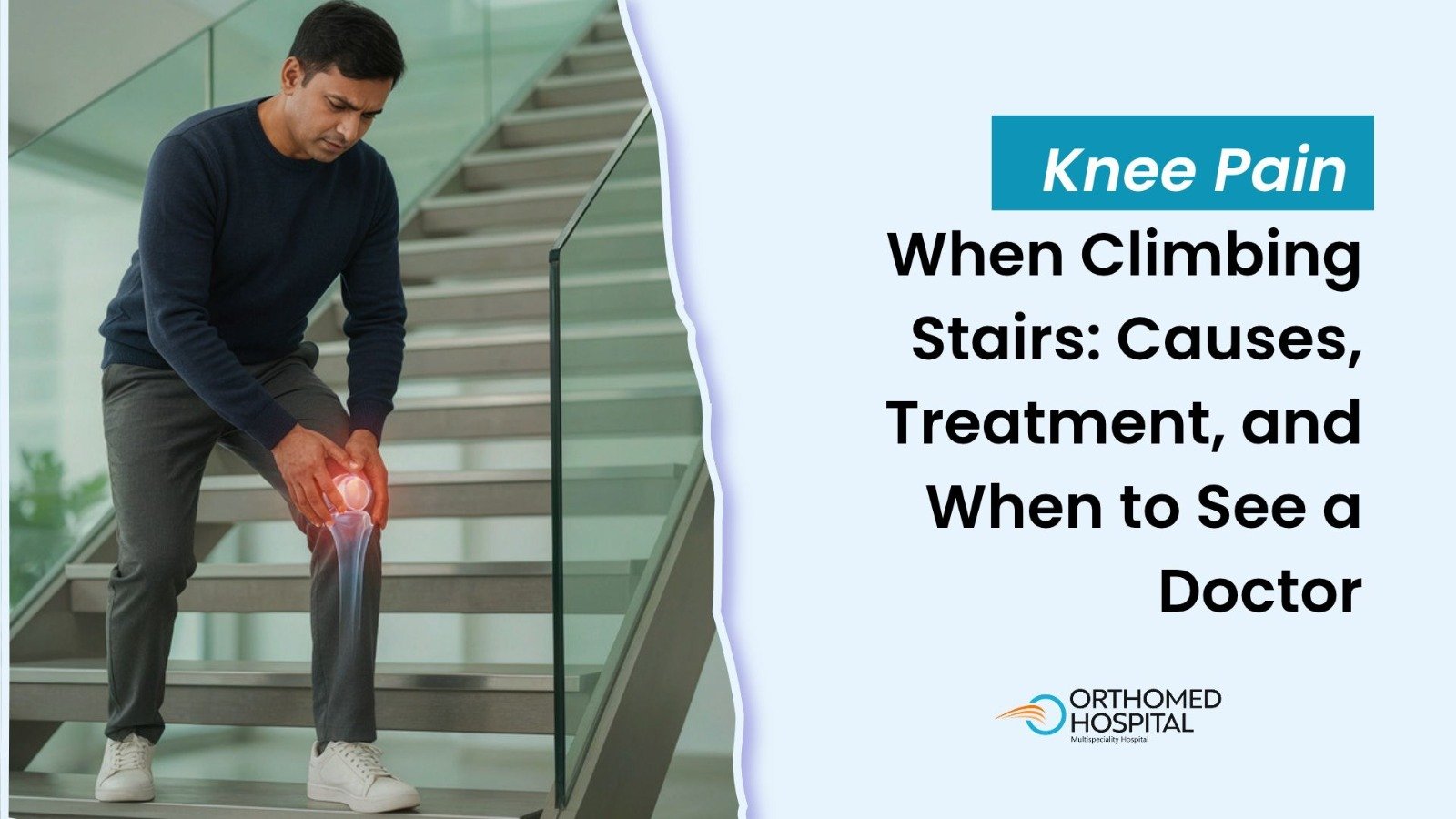
Knee Pain When Climbing Stairs: Causes, Treatment, and When to See a Doctor
You walk around the house without much trouble. Then you reach the staircase, and with every step up, your knee complains. Maybe it is a dull ache around the kneecap. Maybe a sharp twinge. Maybe a grinding feeling that makes you grab the railing.
Knee pain when climbing stairs is one of the most common complaints orthopaedic doctors hear. It affects young athletes, office workers, homemakers, and older adults alike. Stairs are simply one of the hardest everyday tasks for the knee, so they tend to reveal problems that flat walking hides.
The good news is that most causes of stair-related knee pain are treatable, and many improve with the right exercises and habits. This guide explains why stairs hurt, the common causes, treatment options, helpful exercises, and when it is time to see an orthopaedic doctor.
Why Stairs Are So Hard on Your Knees
When you walk on flat ground, your knee carries roughly your body weight with each step. When you climb stairs, the load on the knee rises sharply, to several times your body weight. The knee has to bend more deeply, and the thigh muscles have to work much harder to lift your body up.
Much of this force passes through the joint between the kneecap (patella) and the thigh bone (femur), known as the patellofemoral joint. If the cartilage there is worn, the kneecap is not tracking smoothly, or the muscles supporting the knee are weak, stairs are where you feel it first.
Going downstairs is often worse for some people, because the thigh muscles have to control the body as it lowers, which puts a different kind of strain on the knee. Whether the pain is worse going up or down can give your doctor useful clues.
Common Causes of Knee Pain on Stairs
Here are the most frequent causes of knee pain on stairs, and what each typically feels like.
Patellofemoral pain syndrome (runner’s knee)
This is one of the most common causes, especially in teenagers, young adults, and active people. It causes a dull ache around or behind the kneecap. Pain is worse with stairs, squatting, kneeling, and sitting for long periods with the knees bent (sometimes called the “theatre sign”).
It is often linked to weak thigh and hip muscles, tight muscles around the knee, flat feet, sudden increases in activity, or poor alignment of the kneecap.
Knee osteoarthritis
Osteoarthritis is the wear and tear of the cartilage that cushions the knee joint. It is very common after the age of 50, and in India it often starts earlier than many people expect. It is more common in women and in people who are overweight.
Knee pain while going upstairs is often an early sign. Other signs include stiffness in the morning or after sitting, a grinding or crackling sound, swelling, and pain that worsens as the day goes on.
Chondromalacia patella
This is softening and breakdown of the cartilage on the underside of the kneecap. It causes pain at the front of the knee, especially with stairs, squatting, and kneeling, and sometimes a grinding feeling. It is often seen in younger people and may overlap with patellofemoral pain.
Patellar tendinitis (jumper’s knee)
The patellar tendon connects the kneecap to the shin bone. Overuse from jumping, running, or sports can inflame it. Pain is felt just below the kneecap and gets worse with climbing stairs, jumping, or getting up from a chair.
Meniscus tear
The menisci are two C-shaped cartilage pads that act as shock absorbers inside the knee. They can tear during sudden twisting in sports, or gradually with age. A meniscus tear may cause pain on the inner or outer side of the knee, swelling, a catching or locking sensation, and difficulty with stairs and squatting.
Knee bursitis
Small fluid-filled sacs called bursae cushion the knee. Kneeling for long periods, for example while cleaning floors or during prayer, can inflame them, causing swelling and tenderness that make stairs uncomfortable.
Iliotibial band syndrome
Common in runners and cyclists, this causes pain on the outer side of the knee. It can flare up with stairs, especially going down.
Previous injury or ligament problems
Old injuries, including ligament tears such as an ACL injury, can leave the knee less stable, leading to pain and a feeling of giving way on stairs.
Factors That Make Stair Pain More Likely
Several everyday factors increase the strain on your knees:
- Excess body weight. Every extra kilogram adds load to the knee on each step.
- Weak muscles. Weak quadriceps, glutes, and hip muscles leave the knee joint to take more stress.
- Inactivity. Long hours of sitting weaken the muscles that support the knee.
- Sudden increase in activity, such as starting a new running routine too quickly.
- Poor footwear or flat feet that affect leg alignment.
- Age, as cartilage naturally thins over the years.
- Floor-level habits. Squatting and sitting cross-legged for long periods are common in Indian homes and can aggravate existing knee problems.
Knee Pain Treatment Options
Treatment depends on the cause, but most people start with simple, non-surgical approaches. Here is an overview of knee pain treatment options.
Self-care at home
- Relative rest. Reduce activities that cause pain, such as unnecessary stair trips, deep squats, and kneeling, without becoming completely inactive.
- Ice. Apply an ice pack wrapped in a cloth for 15 to 20 minutes after activity to reduce swelling.
- Heat. For stiffness from arthritis, a warm compress can ease the joint before activity.
- Weight management. Even modest weight loss can significantly reduce knee pain in people with osteoarthritis.
- Supportive footwear. Cushioned shoes with good arch support help.
- Use the railing. On stairs, hold the railing and lead with your stronger leg going up and your painful leg going down. Many patients remember this with the phrase “up with the good, down with the bad.”
Medicines
Your doctor may recommend pain relievers or anti-inflammatory medicines for short periods. Topical gels can also help. Avoid taking painkillers regularly without medical advice, as long-term use can affect the stomach and kidneys.
Physiotherapy
Physiotherapy is one of the most effective treatments for stair-related knee pain. A physiotherapist will assess your muscle strength, flexibility, and movement patterns, then design a programme to strengthen the muscles that support the knee and correct the problems that are causing pain.
Injections
For osteoarthritis that does not respond to other treatment, doctors may suggest steroid injections to reduce inflammation, or other injectable options such as hyaluronic acid or platelet-rich plasma (PRP) for selected patients. Your doctor will explain which, if any, suits your condition.
Bracing and taping
A knee brace or kinesiology taping may help some patients by supporting the kneecap or reducing load on one side of the joint.
Surgery
Surgery is needed only in a minority of cases. Options include:
- Arthroscopy (keyhole surgery) to repair or trim a torn meniscus or treat certain cartilage problems
- Ligament reconstruction for unstable knees after injury
- Cartilage procedures for specific cartilage defects
- Total or partial knee replacement for advanced osteoarthritis that severely affects daily life despite other treatment
Exercises for Knee Pain While Climbing Stairs
Strengthening the muscles around your knee and hip takes pressure off the joint. Here are some simple exercises for knee pain while climbing stairs. Start slowly, and stop any exercise that causes sharp pain. If you have a diagnosed condition, check with your doctor or physiotherapist first.
- Quadriceps sets
Sit or lie with your leg straight. Tighten the muscle on top of your thigh, pressing the back of your knee down towards the floor. Hold for 5 seconds, relax. Repeat 10 to 15 times.
- Straight leg raises
Lie on your back with one knee bent and the other leg straight. Tighten the thigh of the straight leg and lift it about a foot off the floor. Hold for 3 seconds, lower slowly. Do 10 to 15 on each side.
- Glute bridges
Lie on your back, knees bent, feet flat. Squeeze your buttocks and lift your hips until your body forms a straight line from shoulders to knees. Hold for 3 seconds, lower. Repeat 10 to 15 times.
- Side-lying leg raises
Lie on your side with legs straight. Lift the top leg up towards the ceiling, keeping your toes pointing forward. Lower slowly. Do 10 to 15 on each side. This strengthens the hip muscles that keep your knee aligned.
- Clamshells
Lie on your side with knees bent and feet together. Keeping your feet touching, lift your top knee like a clamshell opening. Lower slowly. Repeat 10 to 15 times on each side.
- Wall sits (partial)
Stand with your back against a wall and slide down slightly, bending your knees to a comfortable, shallow angle. Hold for 10 to 20 seconds. Increase the time gradually as you get stronger.
- Step-ups
Once the exercises above feel comfortable, stand in front of a low step. Step up with one foot, bring the other up, then step down slowly. Start with a very low step and use a railing for support. Repeat 10 times on each side.
- Hamstring and calf stretches
Tight muscles at the back of the leg add strain to the knee. Gently stretch your hamstrings and calves daily, holding each stretch for 20 to 30 seconds.
Consistency matters more than intensity. Doing these exercises a few times a week over several weeks usually brings noticeable improvement.
When to See an Orthopaedic Doctor for Knee Pain
Mild knee pain that improves with rest and exercise within a couple of weeks often does not need a specialist. But you should know when to see an orthopaedic doctor for knee pain. Book an appointment if:
- The pain lasts more than two to three weeks despite rest and home care
- The pain is getting worse over time
- Your knee is swollen, warm, or red
- Your knee locks, catches, or gives way
- You cannot fully straighten or bend your knee
- You heard a pop at the time of an injury
- Pain wakes you up at night
- You cannot bear weight on the leg
- Stairs have become so difficult that you avoid them
- Knee pain is affecting your work, sleep, or daily life
Seek urgent care if your knee becomes suddenly very swollen, hot, and painful with fever, as this can indicate infection.
During your visit, the doctor will examine your knee, test its movement and stability, and may suggest an X-ray or MRI to see the bones, cartilage, and ligaments clearly.
Protecting Your Knees for the Long Term
A few habits go a long way:
- Stay active with low-impact exercise like walking, swimming, or cycling
- Keep your thigh and hip muscles strong
- Maintain a healthy body weight
- Warm up before sports and exercise
- Avoid long periods of squatting or kneeling if your knees are already sore
- Wear supportive shoes
- Do not ignore knee pain that keeps returning
Knee Care at Orthomed Multispeciality Hospital
At Orthomed Multispeciality Hospital in Chennai, our Orthopaedics and Sports Medicine teams treat the full range of knee problems, from early patellofemoral pain to sports injuries and advanced arthritis. Treatment options range from physiotherapy and injections to arthroscopic meniscus repair, ACL reconstruction, cartilage procedures, and total knee replacement. Our home physiotherapy service also helps patients continue their recovery without having to travel.
Final Thoughts
Knee pain when climbing stairs is your knee’s way of telling you something needs attention. In many cases, the cause is muscle weakness, kneecap tracking problems, or early wear in the joint, all of which respond well to exercise, weight management, and timely care.
The earlier you address it, the easier it is to treat. If stairs have started to feel like a challenge, book a consultation with the orthopaedic specialists at Orthomed Multispeciality Hospital, Chennai. Call us at +91 99400 99992 to schedule your appointment.
Comments are closed